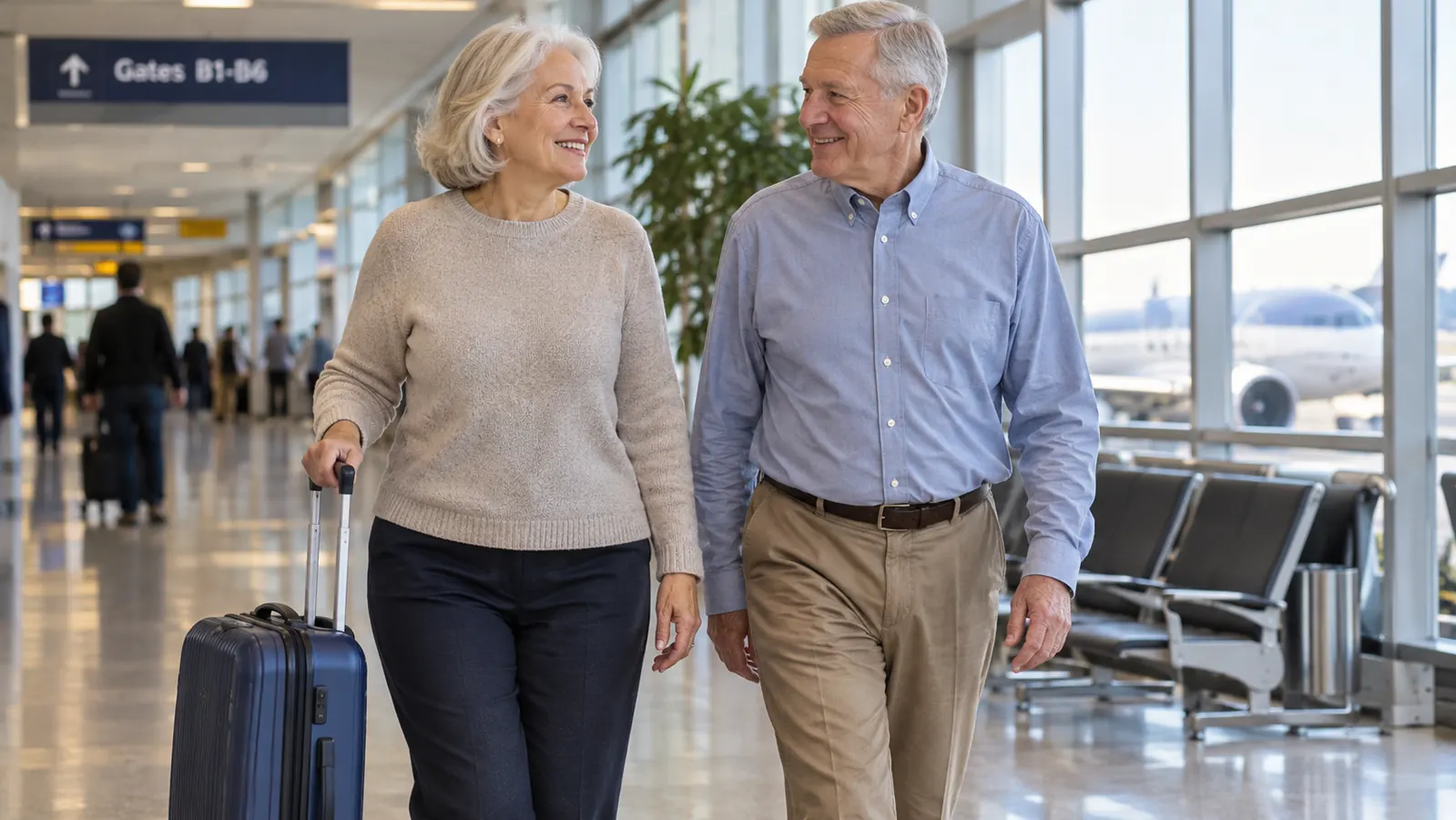
My right shoulder went stiff about twenty years ago and it never fully came back. I mention that because for most of those years I kept packing like a woman whose shoulder was fine. I would fill a duffel, sling the strap over my good side, and by the time I reached the gate in Billings my whole arm would be humming. Then I would hand the bag to Ron and spend the rest of the trip quietly annoyed at myself.
Two-wheel bags were not much better. You drag them behind you at an angle, which means your shoulder is doing the steering whether you notice it or not. What finally changed things for me was a four-wheel spinner with a hard shell and a handle tall enough that I did not have to stoop. The one I have hauled on my last several trips is the Kenneth Cole REACTION Out of Bounds 24-inch checked spinner. It is a checked bag. It weighs 8.5 pounds empty, it holds 50.9 liters, and it rolls on four wheels instead of two. None of that is dramatic. All of it matters when your shoulder is the thing you are trying to protect. Here is the routine I have settled into.
The bag that got me out of the habit of carrying anything on my shoulder
Four 360-degree spinner wheels, a telescopic handle that stays where you set it, 8.5 pounds empty, and a hard shell with molded corner guards. The same bag I check on the flight to Denver and on the Empire Builder.
Amazon Check Today's Price on Amazon →Step 1: Weigh the bag before you leave the driveway
The best thing I ever did for my shoulder was buy an inexpensive luggage scale. Not because I care what the airline charges, but because a number on a little screen is honest in a way that a handle in your hand is not. I had been guessing for years, and I had been guessing low.
Here is the arithmetic that changed my mind. A checked bag gets lifted four times on a normal trip: from the house to the car, from the car to the check-in counter, off the carousel onto a cart, and out of the trunk at the other end. Four lifts of a heavy bag hurt my shoulder more than a hundred pushes ever did. So the total weight matters far less than the number of times I have to raise it, and pushing is the part I can actually control.
The Out of Bounds 24-inch starts at 8.5 pounds empty, which sounds like nothing until you realize it leaves you a real budget. I pack to the point where I can still lift the bag to waist height with my left arm alone. If I cannot, something comes out, and it is usually a second pair of shoes. Capacity is 50.9 liters, which in practice is a week of clothes for me if I roll them, or five days if I pack flat and bring the hairdryer.
Step 2: Set the handle height once and leave it alone
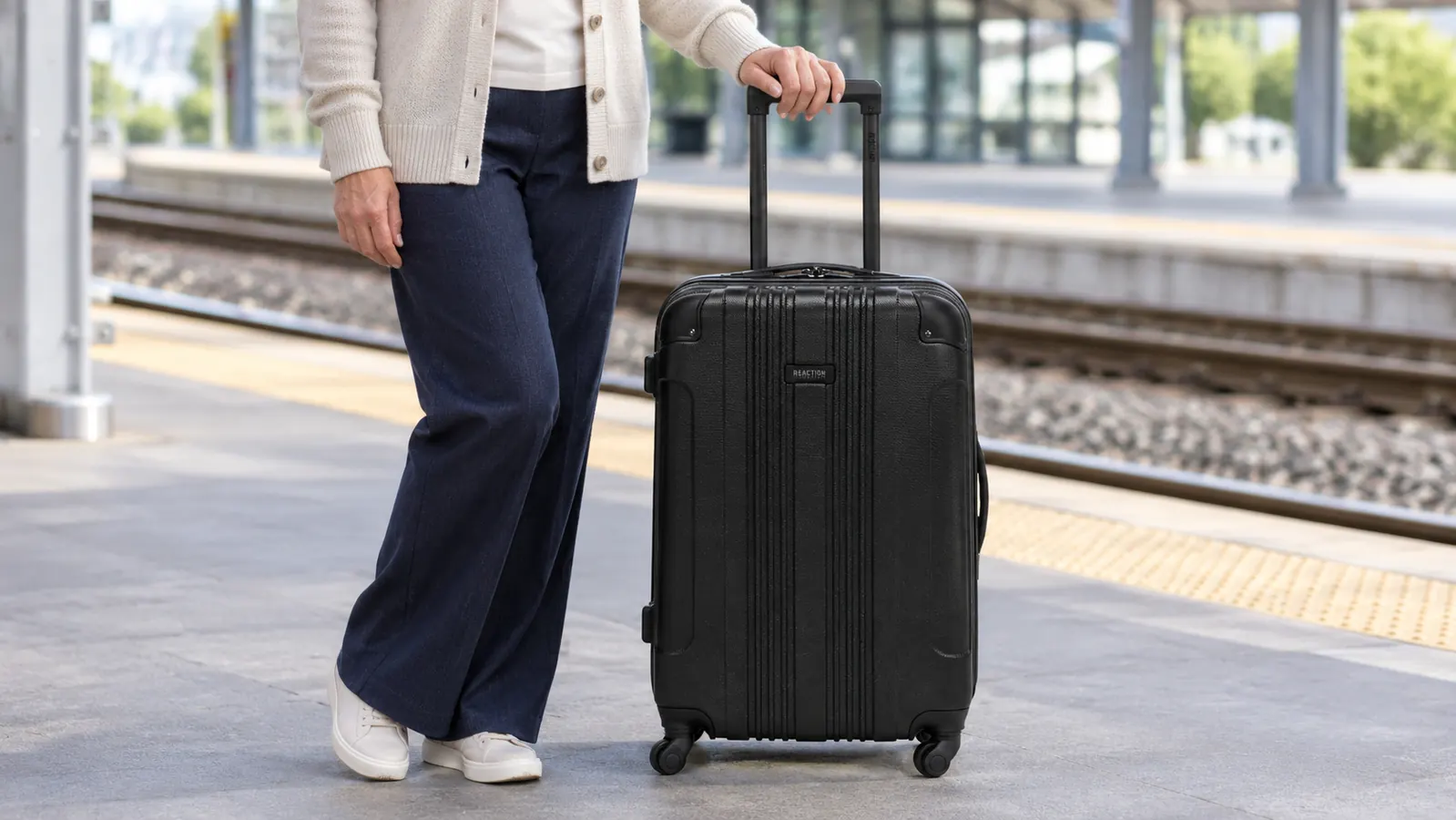
The trolley handle on this bag is telescopic with a push button release, and it is built so you can work it with one hand. That one-handed part matters more than it sounds. When your right shoulder is stiff, you do not want to be holding a bag steady with one hand while you fiddle with a release with the other.
Set the height so the grip lands somewhere between your hip bone and the top of your thigh. Stand up straight when you do it. If the handle is too low you will stoop, and if it is too high your shoulder will creep up toward your ear without you noticing until dinnertime.
I set mine in the hallway at home, before the trip, and then I leave it. Ron made the point once that I was adjusting it at every curb like it was a car seat, and he was right. Every adjustment is a chance to set it wrong while you are in a hurry. There are two handles on the bag: the telescopic trolley handle you wheel it with, and a top grab handle for lifting. Learn which one is which, and stop lifting with the trolley handle. It is not built for that, and neither is your shoulder.
Step 3: Push it beside you instead of dragging it behind
Four spinner wheels are the whole reason I switched. A two-wheel bag tips toward you and you drag it at an angle behind your body, which means your shoulder is quietly steering forty pounds for the length of the terminal. A four-wheel spinner stands up on its own and rolls in any direction, and you walk beside it with your hand resting on the handle. The Kenneth Cole REACTION bag has four of those wheels, each turning a full 360 degrees.
The motion is closer to walking with a shopping cart than to hauling a suitcase. Arm relaxed, elbow slightly bent, hand loose on the grip. If your knuckles are white, you are working too hard and you will feel it by the time you reach the gate.
Because the wheels turn in every direction, you can move the bag alongside you in a crowded concourse instead of swinging it out behind you where it catches ankles. In Billings the floor is smooth and it glides. In Denver the carpet near the carousel takes a bit more of a shove, and that is fine, because a shove is still a push and not a pull. The one place I go back to two wheels is a curb or a threshold, and I will get to that.
Step 4: Pack it so it rolls straight
A spinner that is packed badly will wander. If the heavy things all sit on one side, the bag pulls toward that side and you spend the whole walk correcting it, which puts the strain right back into your shoulder.
This bag opens flat and packs on two sides with a zippered divider between them. I put shoes, the hairdryer and anything liquid in the bottom of the deep side, pressed as close to the middle of the bag as I can manage. Clothes go on top and around them. The shallow side gets the light things: sleep clothes, a sweater, and the bag of charging cables I always overpack. There are tie-down straps inside to hold the layers in place, and I use them. A bundle that shifts in transit turns into a bag that rolls crooked by the second airport.
The shell is hard, made from ABS and PC with molded corner guards, so the case does not sag or bulge when it is full. That is worth something to a person with a bad shoulder, because a soft bag that has settled into a lopsided shape drags no matter how many wheels it has. Mine has been thrown onto the belt in Billings and pulled off the carousel in Denver and it still sits square on the floor.
Step 5: Stairs, platform gaps, and the back of the car
This is a checked bag, so there is no wrestling it into an overhead bin, and that is half of why I like it. It goes in the hold and meets me at the carousel. The remaining hard parts are stairs, train platforms, and the lip of a car trunk.
For stairs, tip the bag back onto two wheels and take the steps one at a time, pulling it up behind you with your good arm on the top grab handle. Do not carry it. Even at 8.5 pounds empty, it is not a bag you want to deadlift in a stairwell. On Amtrak, there is a gap between the platform and the step into the car, and the step is high. I hand the bag to the attendant and I do not apologize for it. They do this all day and they are better at it than I am.
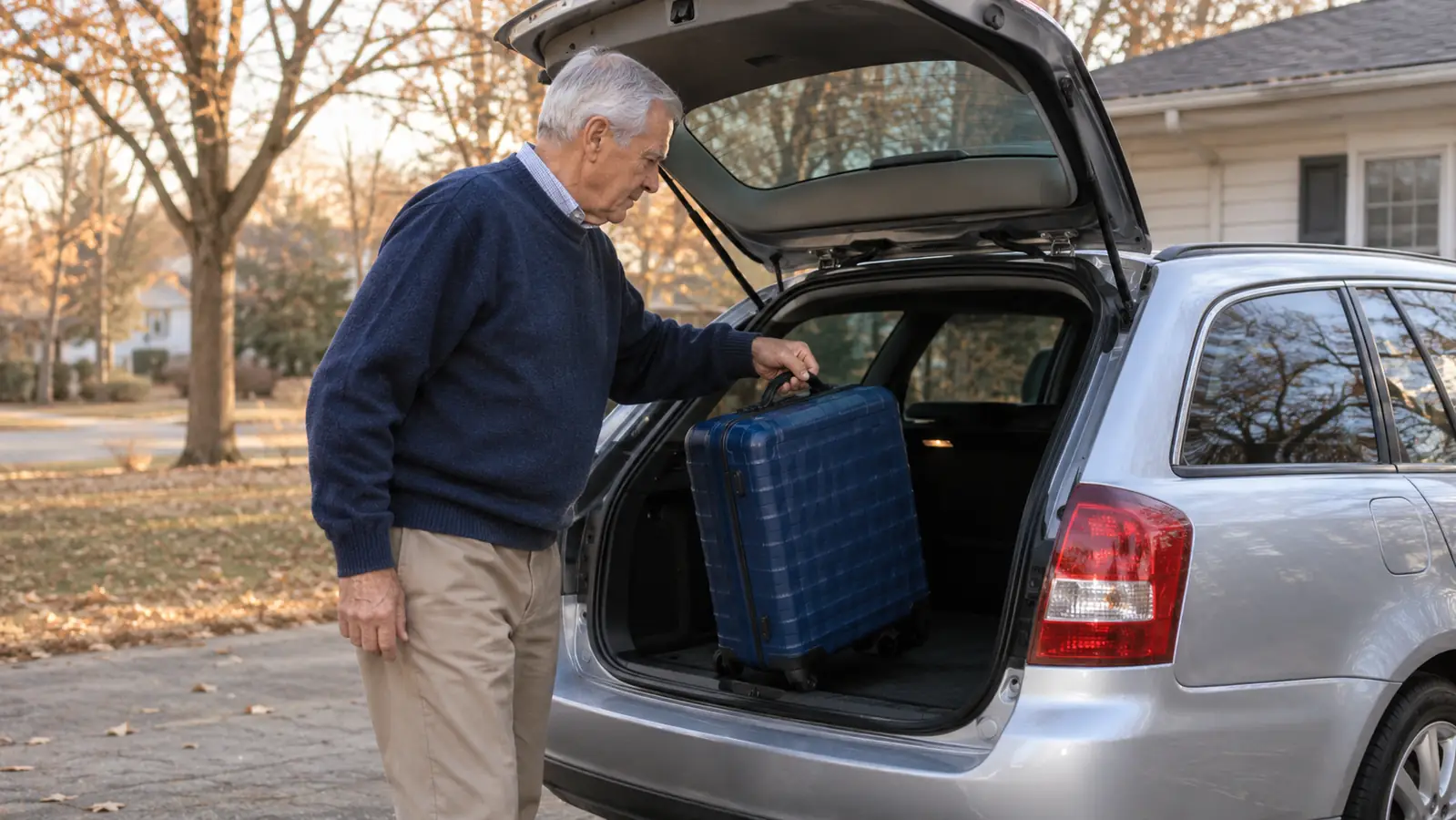
At the car, lift with your legs and set the bag in the trunk rather than swinging it. The Outback has a low lip, which helps. If you drive something taller, tip the bag in on its wheels and let it slide. Ron takes the heavier bag because he packs light and has the shoulders for it, and I take the handrail. That arrangement has kept both of us upright for a lot of years. None of this is complicated. It is just a set of habits that keep a bad shoulder from getting worse on a trip you were supposed to enjoy.
What Else Helps
Two small things I did not expect to care about. The bag takes a pad lock rather than having one built in, so I keep a small one in the outside pocket and lock the main compartment when I check it. The shell is water resistant, which has mattered exactly twice, both times on a wet tarmac, and both times my clothes were dry at the other end. The Kenneth Cole REACTION Out of Bounds also comes with a manufacturer's limited lifetime warranty against defects in materials and workmanship. I have not had to use it. I mention it because at this age I have stopped buying things I expect to replace in three years.
Buy a luggage scale. Buy packing cubes so you can lift one layer out instead of digging with your arm buried in the bag. Tie something bright to the handle so you can spot it coming down the carousel without lunging. And ask for help when help is standing right there. Skycaps, gate agents, the young man behind the rental car desk: they will lift a bag, and the only cost is saying yes out loud.
One more note on size. This is the 24-inch checked bag, and the case measures 14.5 by 8.5 by 21.75 inches. That has kept it inside the usual allowance most domestic carriers publish, though you should check your own airline before you fly, because those numbers move around. A 24-inch spinner is the size that has worked on every trip I have taken in the last several years, from the short hop to see my daughter's family in Denver to the long, slow, lovely ride on the Empire Builder.
Four lifts of a heavy bag hurt my shoulder more than a hundred pushes ever did. So I stopped counting pounds and started counting lifts.
If your shoulder is the reason you dread the airport, start with the wheels
Four 360-degree spinner wheels, a telescopic handle that stays where you set it, a top grab handle for the short lifts, 8.5 pounds empty and 50.9 liters inside. The 24-inch checked bag I roll beside me instead of carrying.
Amazon Check Today's Price on Amazon →