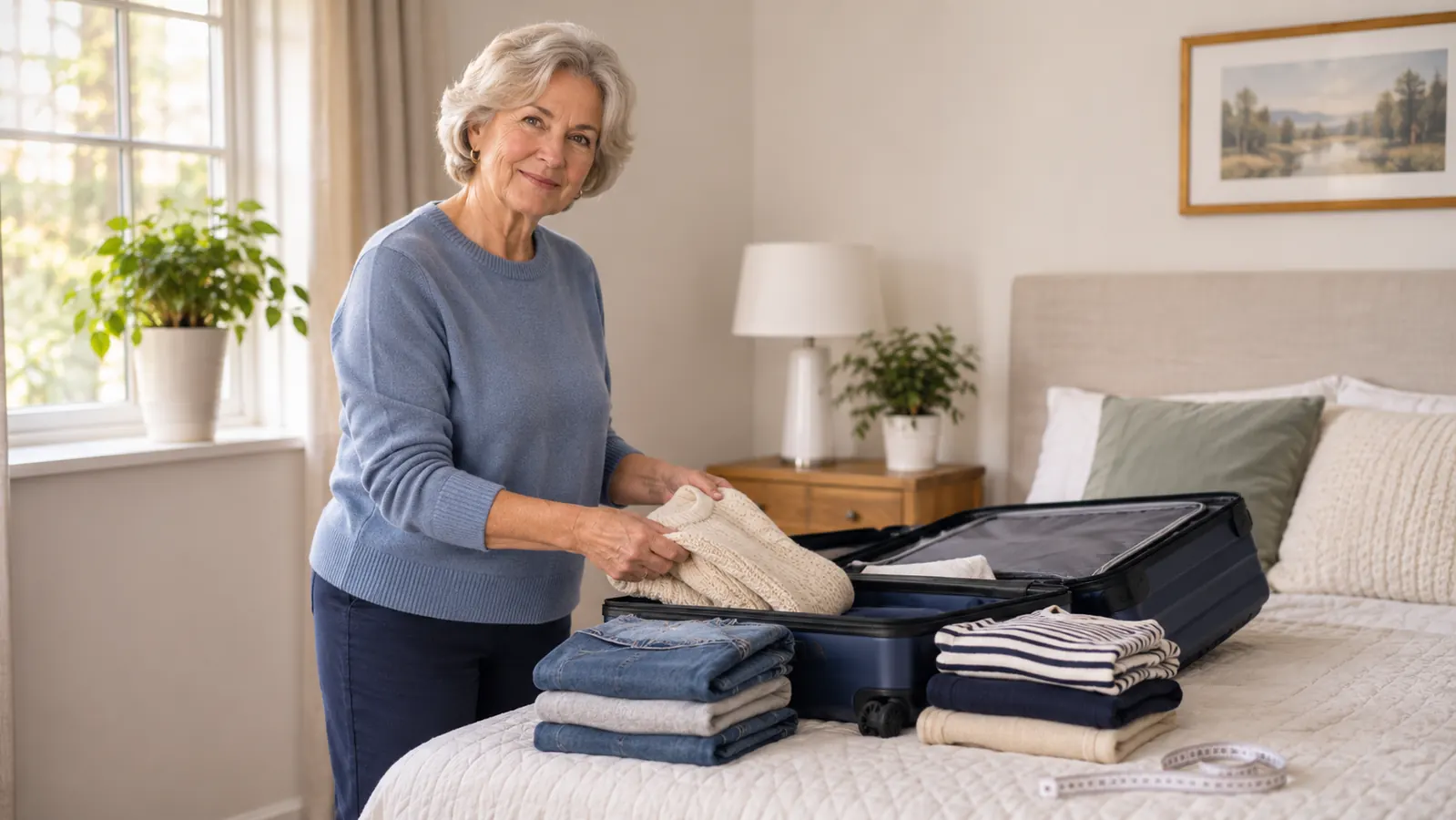
The first time I tried to pack a week into a carry-on, I ended up on the bedroom floor at eleven at night with a bag that would not close and a six in the morning flight to Denver waiting for me. My right shoulder ached from hauling the thing off the closet shelf, and I had that sinking feeling that comes when you realize the problem is not how much you packed. It is the order you packed it in.
I am 64, retired from the school library in Billings, Montana, and I travel more than I expected to. Flights to see my daughter's family in Denver, the Empire Builder when Ron and I want a slow trip, and long drives across Montana and Wyoming in the Outback. A few years ago I settled on the Samsonite Freeform hardside carry-on with the spinner wheels, and it changed my packing more than any gadget ever did. It weighs 6.5 pounds empty, holds 34 liters, and the shell is polypropylene, so it flexes when I lean on it instead of denting.
What follows is the routine I actually use, in the order I use it. It is not clever, it does not require a laminator, and it has gotten me through a ten day train trip without checking a bag.
The case this whole routine is built around
Samsonite Freeform carry-on spinner: 34 liters, 6.5 pounds empty, four oversized multidirectional spinner wheels, expandable, with a built in combination lock. It is the bag I pack in the order below.
Amazon Check Today's Price on Amazon →Step 1: Measure the bag and weigh it before a single sock goes in
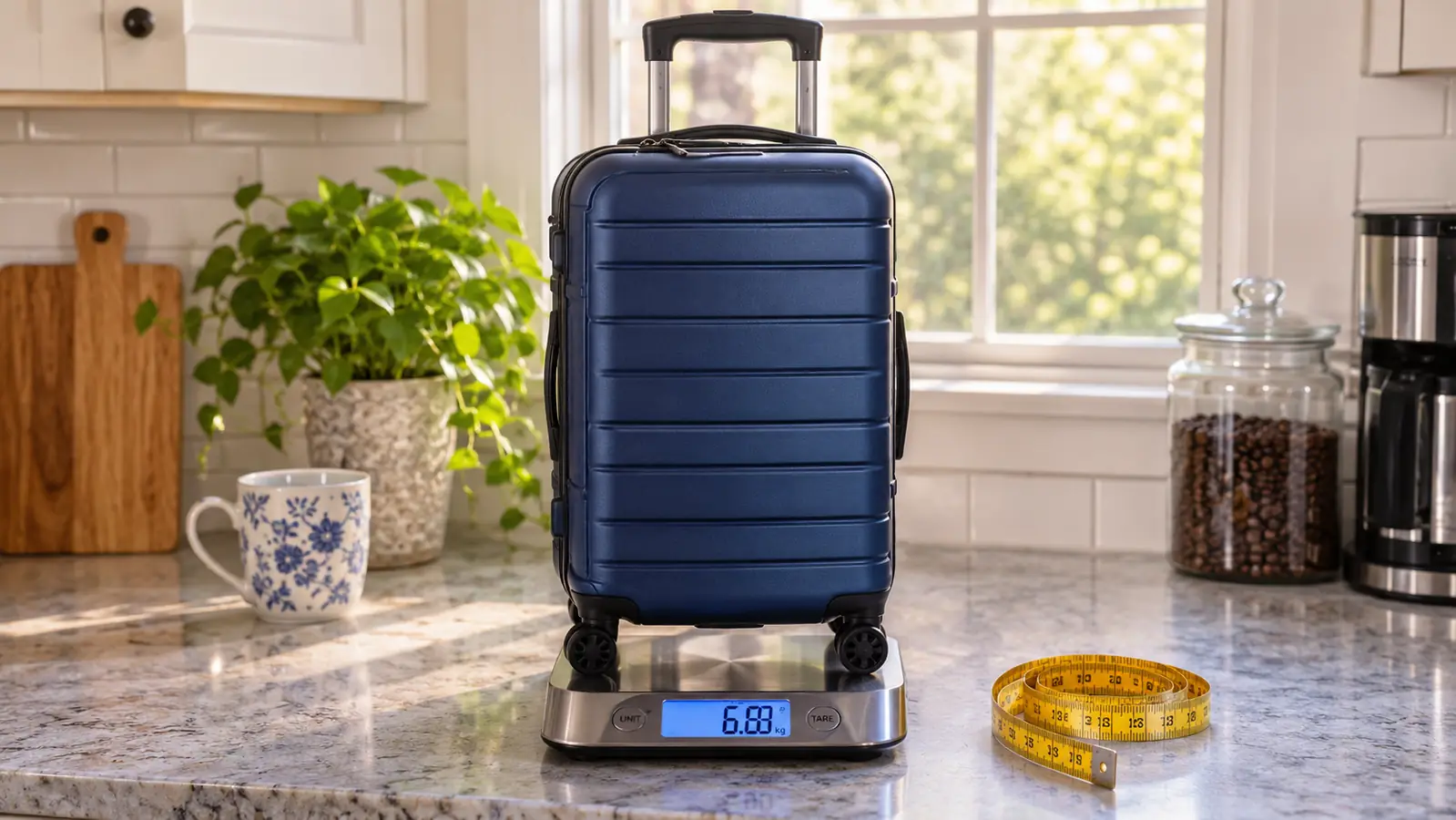
Start with a tape measure, not with clothes. The Samsonite Freeform measures 23 inches tall, 15.3 inches wide and 9.8 inches deep on the outside, and that 23 inches includes the wheels and the handle housing. The packing space inside is 20.5 by 14.5 by 9.8. Those two sets of numbers are not the same, and the gap between them is where most carry-on trouble starts.
Airline sizers measure the whole bag, so I measure the whole bag. Several domestic carriers publish a limit around 22 by 14 by 9 inches, and this case is a touch taller than that. In practice it has gone into every overhead bin I have put it in, including the smaller regional jet out of Billings, but I check the specific airline's page before a trip I have not flown before instead of assuming. Knowing the number in my own kitchen beats finding out at the gate with a line behind me.
Then weigh it. Empty, the bag is 6.5 pounds, which leaves a generous margin before any weight limit you are likely to meet. I set the packed case on the kitchen scale before every flight and keep a hanging luggage scale in the front pocket for the trip home. Amtrak publishes a 50 pound limit for carry-on bags on most trains, and 50 pounds is more room than I have ever needed. The limit I actually bump into is space, not weight.
Step 2: Lay everything on the bed, then take away a third
Lay out everything you think you need where you can see it, then remove a third of it. This is the step people skip, and it is the only one that decides whether the bag closes without a knee involved. Here is the framework I use. Two colors that go together, so every top works with every bottom. Four days of clothes plus one extra set of underthings. That is it.
Shoes are the space thieves. I wear the bulkiest pair on the plane and pack one other pair at most, with socks stuffed inside them to use the hollow. Ron, who is 66, a retired surveyor, and has never in his life overpacked anything, puts his second pair in a cloth bag and considers the matter closed.
Roll the soft things and fold the stiff things. Rolled shirts and trousers fill gaps and arrive with fewer creases than you would expect. Folded collared shirts stay flat and go in the lid. I use two packing cubes, one for tops and one for bottoms, and I press the air out with the flat of my hand before zipping. The cubes are not magic, they just keep loose items from sifting into every corner of the case.
The liquids bag goes in last and comes out first. One quart bag, standing upright at the top of the case or in the personal item. I have unpacked an entire suitcase in a security line exactly once and I have no plans to do it again.
Step 3: Load the deep half first with the weight near the wheels
Open the case like a book. The deep half is the packing half and the shallow half is the lid. Clothes you would not mind wrinkling go in the deep half. Clothes you would mind go in the lid, flat, with nothing folded over itself more than once.
Put the heaviest items closest to the wheels. When the bag stands upright, which is how it spends most of its life, the weight settles toward the bottom, and a bag with weight at the bottom rolls straight instead of wobbling. Shoes, the hair dryer, the pouch of chargers, all of that goes down low. Sleepwear, scarves and the thin cardigan go on top where they do not crush anything.
Fill the corners. The interior of the Samsonite case is a rectangle, 20.5 by 14.5 by 9.8, but the corners of a packed bag are almost always empty air. Socks, a belt, a rolled scarf, the spare charger, all of it goes in the corners. Then pull the elastic tie-down strap across the top, press down with your forearm, and zip the divider. That strap is the reason the whole layer stays put when someone else handles the bag without being gentle.
Nothing loose on the lid side. If you zip a single loose item into the lid, it slides to the hinge and lands in a lump at the bottom of the case by the time you reach Denver. Flat layers only.
Step 4: Use the lock, the expansion zip and the handles the way they were designed
Set the combination lock at home, not at the airport. The built in lock is a combination lock, so the number lives in your head or your phone. I set mine at the kitchen table, spun it twice to test it, and wrote the number in my notes app. Trying to remember whether it was the year we married or the year we moved, with a line of people behind you, is not a good use of anyone's morning.
The expansion zipper is for the trip home, not the trip out. Expanding adds depth, and depth is exactly what a sizer measures. I fly out with it closed and only open it if I buy something in Denver, and then I check the number again before I head to the airport.
There are two carry handles on this case plus the telescopic handle, and you will use all three. The telescopic handle is for rolling upright. The top and side handles are for lifting the bag into an overhead bin, onto a train rack, or out of the back of the Outback. I lift with the side handle and my left hand, because my right shoulder has opinions about overhead lifting, and I would rather listen to it than argue.
Do not overstuff. A hardside case packed to the shell has nowhere to give, so the zipper takes the entire load. If I have to lean on the bag to close it, something comes out. That rule has never once been wrong.
Step 5: Handle it correctly in the airport and on the train
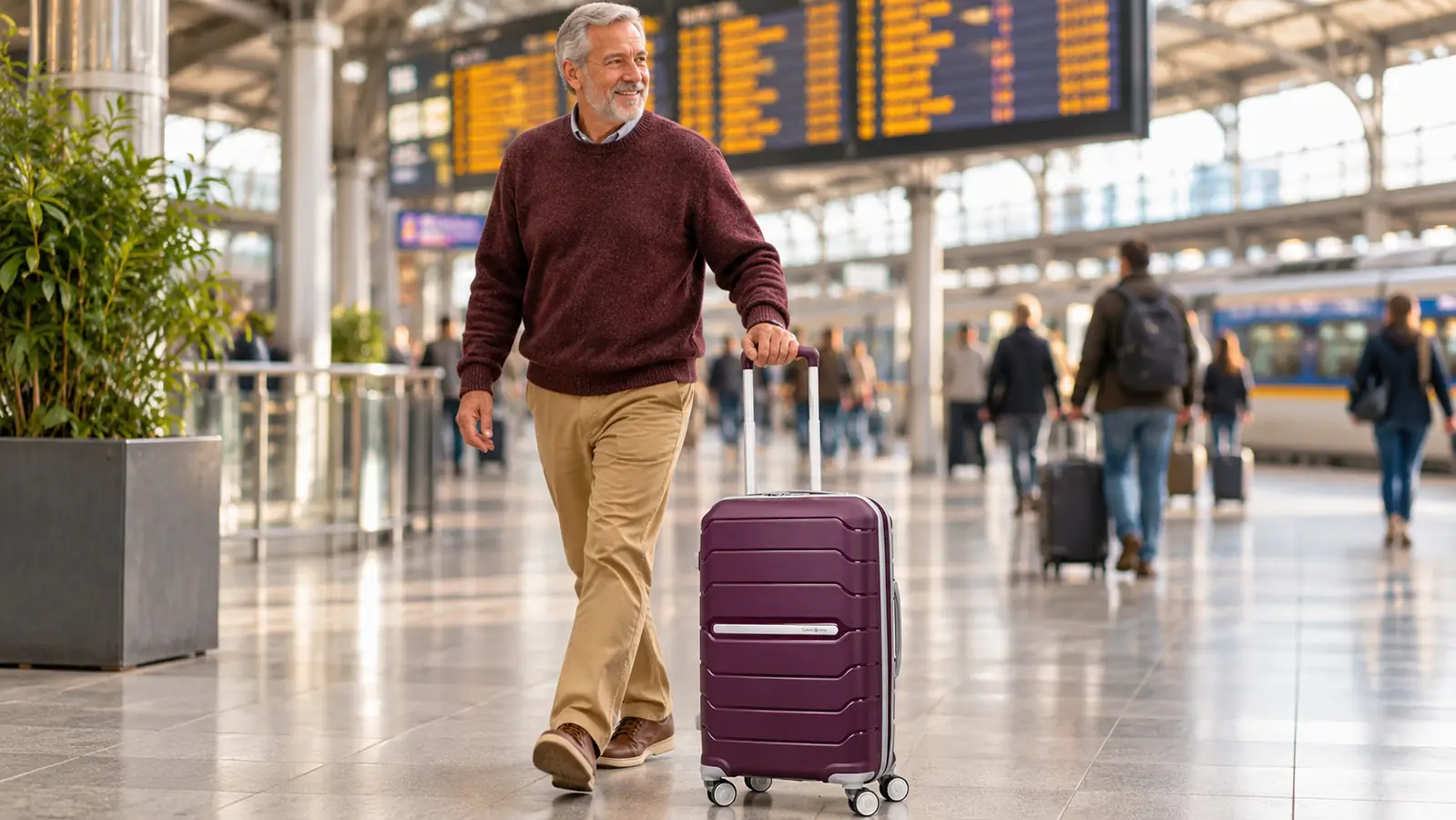
Roll it upright on all four spinner wheels whenever the floor is smooth. Tile, terrazzo, the jet bridge, the platform at the station. All four wheels carry the weight and the bag steers with a fingertip, which is the entire reason I bought a spinner. Tilt it onto two wheels only on carpet or a rough sidewalk, and use your good arm when you do.
On Amtrak, the bag goes up. The Empire Builder has an overhead rack above the seat that takes a bag this size, and there is a luggage tower near the door of most coaches. I use the rack when I am sitting for hours because I want my bag where I can see it, and I use the tower when the rack is full. Lifting a loaded bag above your head on a moving train is a two hand job. Ask me how I know.
Watch for the gate check. On the smaller regional planes, a bag this size sometimes gets tagged at the gate and handed back on the jet bridge at the other end. That is fine, but it means the combination number matters and the liquids bag should not be inside. My rule: anything I would panic about losing stays in the personal item under the seat in front of me.
What Actually Fits in 34 Liters
Here is the list I take for a four day trip, and it fills the case without my having to sit on it. Four tops. Two pairs of trousers. One dress or one collared shirt, depending on the occasion. One thin cardigan. Five sets of underthings and socks. One pair of pajamas. One pair of shoes worn on the plane and one packed. A quart bag of toiletries, a phone charger, a paperback, and a small bottle of woolite for the sink.
That is not a list for a two week trip, and I want to be honest about that. Thirty four liters is about four days of clothes, no matter how carefully you fold. For anything longer I plan a laundry stop. A sink, a little soap, and a towel rail in a hotel bathroom will buy you another four days. I have done exactly that on a ten day train trip and never once checked a bag.
The bag is 6.5 pounds empty, which means your clothes get nearly all of the allowance. Everything after that is arithmetic you do at the kitchen table.
What Else Helps
A few small things make the routine hold together. A hanging luggage scale that lives in the front pocket. A collapsible tote that takes the overflow and doubles as a beach bag at the other end. Two packing cubes, not five. A spare pair of glasses in the personal item, because I am 64 and I know myself. None of it costs much and all of it saves a small humiliation somewhere down the line.
The personal item does more work than people give it credit for. Mine holds medications, chargers, a paperback, the thin cardigan, and one full change of clothes. If the carry-on gets gate checked, I can still function for a day without it. That is not pessimism. It is arithmetic, and it is the same arithmetic that made me buy a four wheel spinner and a polypropylene shell in the first place. The Samsonite Freeform is not the lightest case on the shelf or the cheapest, and it will not survive being thrown down a stairwell, but it rolls straight, it fits, and it has never once made me unpack my suitcase in public.
Four days of clothes, four wheels, no checking a bag
34 liters inside, 6.5 pounds empty, expandable for the trip home, with four multidirectional spinner wheels that steer with one finger. The same case described in every step above.
Amazon Check Today's Price on Amazon →