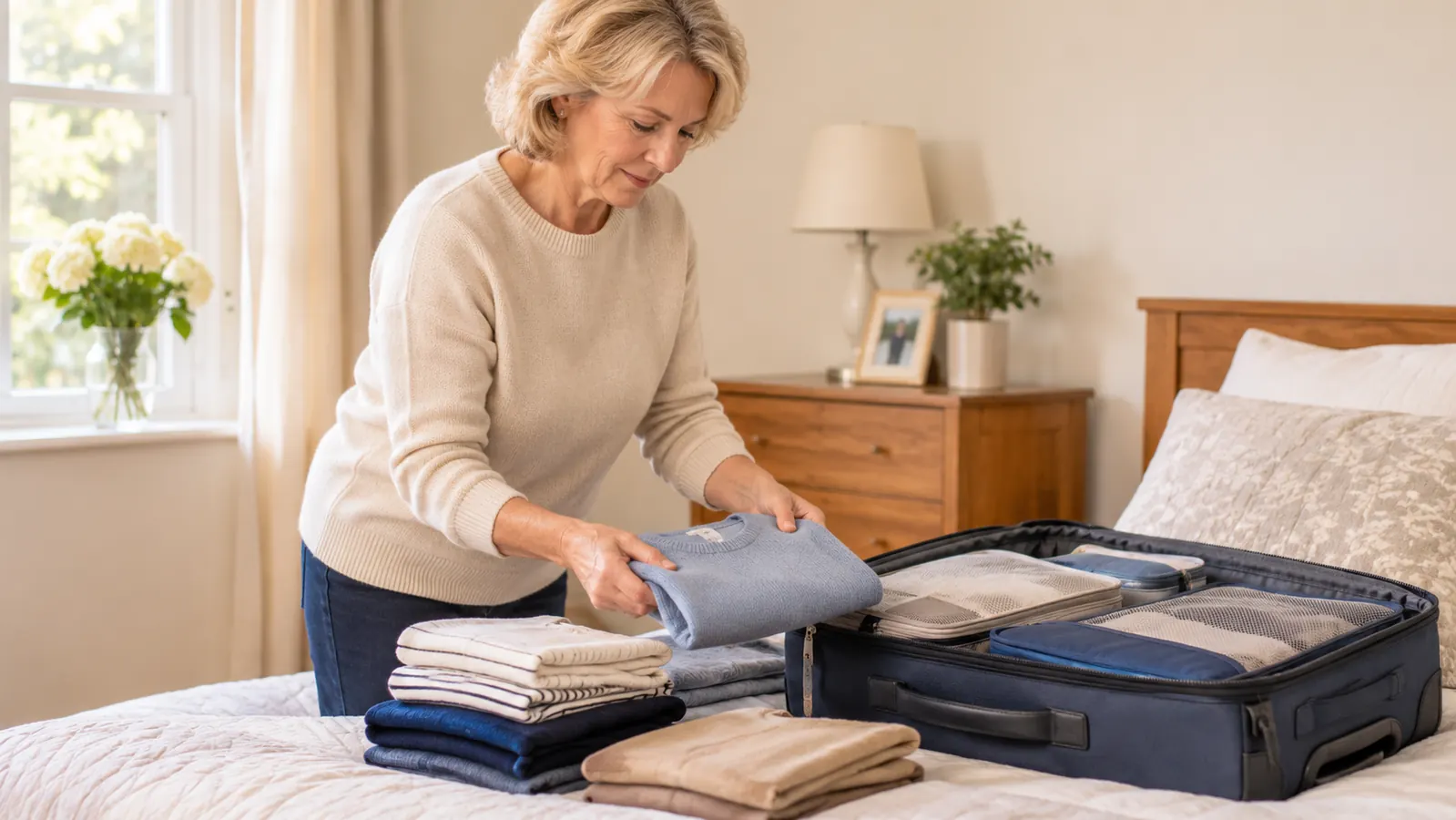
Packing a suitcase never used to bother me. Then my right shoulder started giving out, and a bag that had been fine for thirty years became a thing I had to think about. Now I plan a suitcase the way I used to plan a library inventory: every item gets a place, and the heavy things go where they do the least harm. Packing cubes are the part of that system I wish I had found two decades earlier. The set I use is the Veken 8 set, and once you know how to load it, a carry-on stops being a guessing game. This is the method I run through before every flight out of Billings, every long ride on the Empire Builder, and every drive to see my daughter's family in Denver.
Here is the short version: you are not packing clothes, you are packing categories. A cube turns a suitcase into a drawer, and drawers are something a retired librarian understands in her bones. The five steps below are the ones I actually take, in order, including the mistakes I made first so you can skip them. None of this takes longer than packing badly. It just makes the other end of the trip a five minute job instead of an hour on your knees on a hotel carpet.
Five drawers in a carry-on, from 1.2 pounds of fabric
The Veken 8 set includes an extra large and a large cube with buckle straps, a medium cube, a small cube, a shoe bag, and a hanging toiletry bag with four compartments. Twill polyester, two-way metal zippers, 1.2 pounds for the whole set.
Amazon Check Today's Price on Amazon →Step 1: Start With an Empty Bag and the Real Trip in Front of You
Take everything out of the suitcase first. All of it, including the crumpled grocery bag in the bottom and the spare pair of glasses you forgot was in there. Then put the empty bag on the bed and stand back from it. You want to see the real space you are working with before you start filling it.
Check the carry-on size for the airline you are flying, and check it every year because the numbers move. A bag that boards without comment on one carrier gets gate-checked on another, and gate-checking a bag with a stiff shoulder makes for a long afternoon. I measure mine once a year and write the number on an index card that lives in the front pocket.
One more thing about the empty bag: check the zipper and the handle before you commit to it. A suitcase with a sticky zipper is a suitcase that will be opened with a knife someday. That is not a packing cube problem, but you will blame the cubes when it happens.
Then lay the shape of the trip on the bed. Not the clothes yet, just the shape. Three days in Denver is a different bag than ten days on the train, and neither one is the same as a week of driving across Wyoming in October. Ron packs lighter than I do and always has. I stopped trying to match him years ago and started packing for the weather instead.
Last thing before the clothes come out: look at the cubes themselves. The Veken 8 set gives you four cube sizes plus a shoe bag and the hanging toiletry bag, and they do not all need to come with you. For a three day flight I take the large, the medium, the small, and the toiletry bag, and leave the rest in the closet. The set weighs 1.2 pounds together, so the difference is small either way, but an empty cube still takes up room that a sweater could use.
Step 2: Sort by Category, Not by Day
The mistake I made for years was packing outfits. One cube per day, folded together, so every morning I had to open three cubes to find the one shirt that went with the one pair of pants. It looked organized on the bed and it was useless by Tuesday.
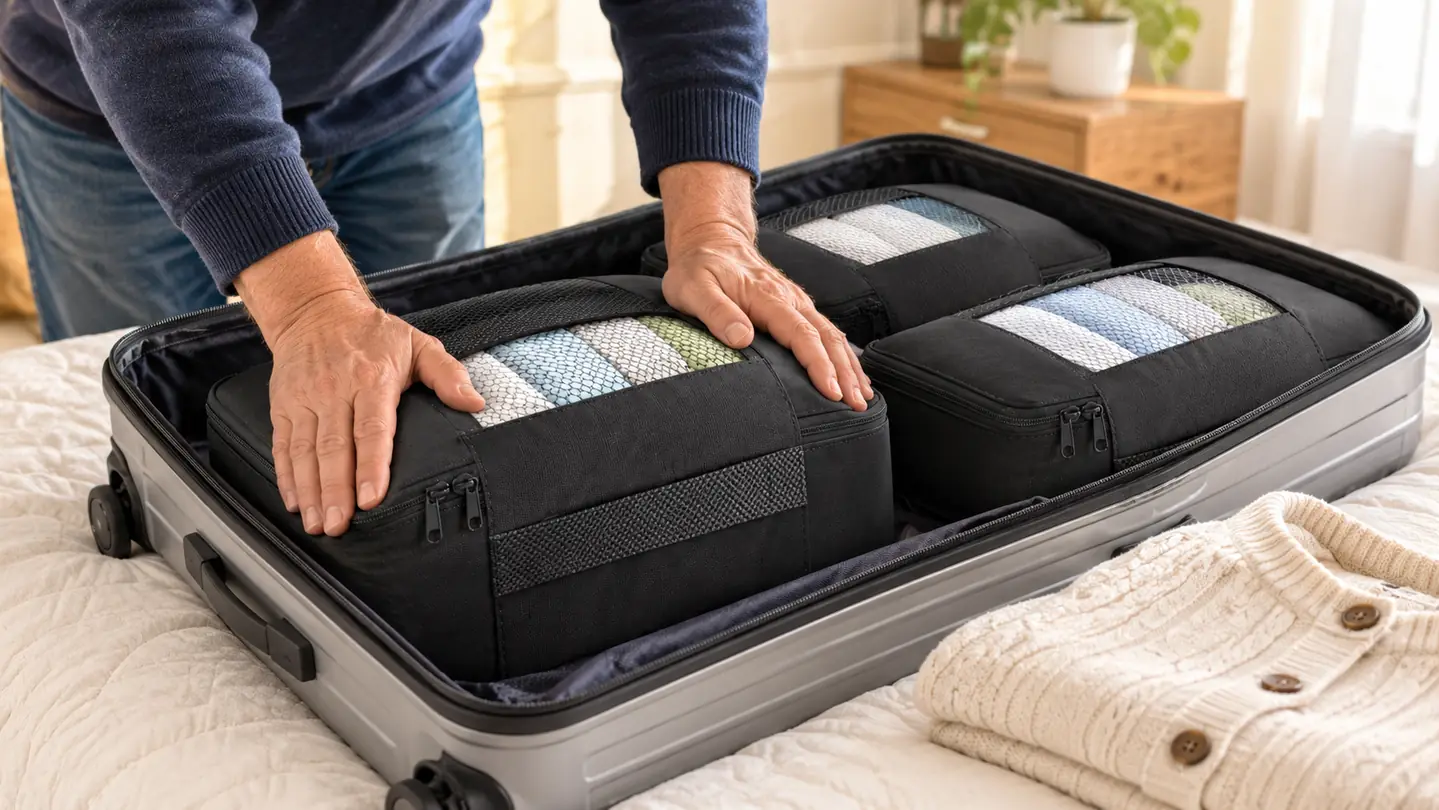
Sort by category instead. Tops in the large cube. Bottoms in the medium. Underthings and socks in the small. Sleepwear and a sweater in the extra large. Shoes in the shoe bag, always, because shoes carry grit and grit ruins fabric. Toiletries in the hanging bag with the four compartments, which hangs on the back of a bathroom door instead of covering the counter in a hotel sink area.
This is the part that pays off in a rental kitchen in Denver or a roomette on the train. You open one cube and you have every top you brought. You are not digging. You are not refolding the whole bag at seven in the morning while your husband waits in the hall.
The hanging toiletry bag earns its place separately. Four compartments means the toothbrush is not rolling around with the shampoo, and the whole thing hangs up out of the way. I keep it packed between trips, refilling it from the bathroom cupboard the week before I leave, so it never becomes a last minute scramble on the morning of a flight.
Step 3: Roll the Soft Things and Fold the Stiff Ones
Soft clothes roll. Knit tops, cotton shirts, sleepwear, anything that bends without creasing. Roll them tight and stand them upright in the cube like books on a shelf, and you can see the edge of every one at a glance.
Stiff clothes fold. Jeans, a blazer, anything with a seam that will show a line. Fold those flat, lay them in the extra large or the large cube, and pull the buckle straps snug. The straps are why those two cubes earn their space. A folded stack that is buckled down stays a folded stack, even after the bag has been lifted into an overhead bin and ridden on the floor of a shuttle bus.
If wrinkles are your worry, the fix is less about technique than about not overfilling. A cube stuffed to the zipper presses creases into everything inside it. A cube that closes without a fight does not. I pack the large cube to about three quarters, buckle it, and let the extra room be the wrinkle insurance.
Rolling also means a cube holds more than you expect, and that is a trap. It is easy to keep adding until the zipper strains. Stop when the cube is firm but not tight, and let the buckle do the work of holding the stack together.
One caution I learned the hard way in Wyoming: do not roll a damp washcloth or a swimsuit in with dry clothes. Wrap anything damp in a plastic bag first, or carry it separately. Twill polyester will survive almost anything except being asked to dry a wet towel next to your shirts for ten hours.
Step 4: Load Heaviest First and Keep the Toiletry Bag Reachable
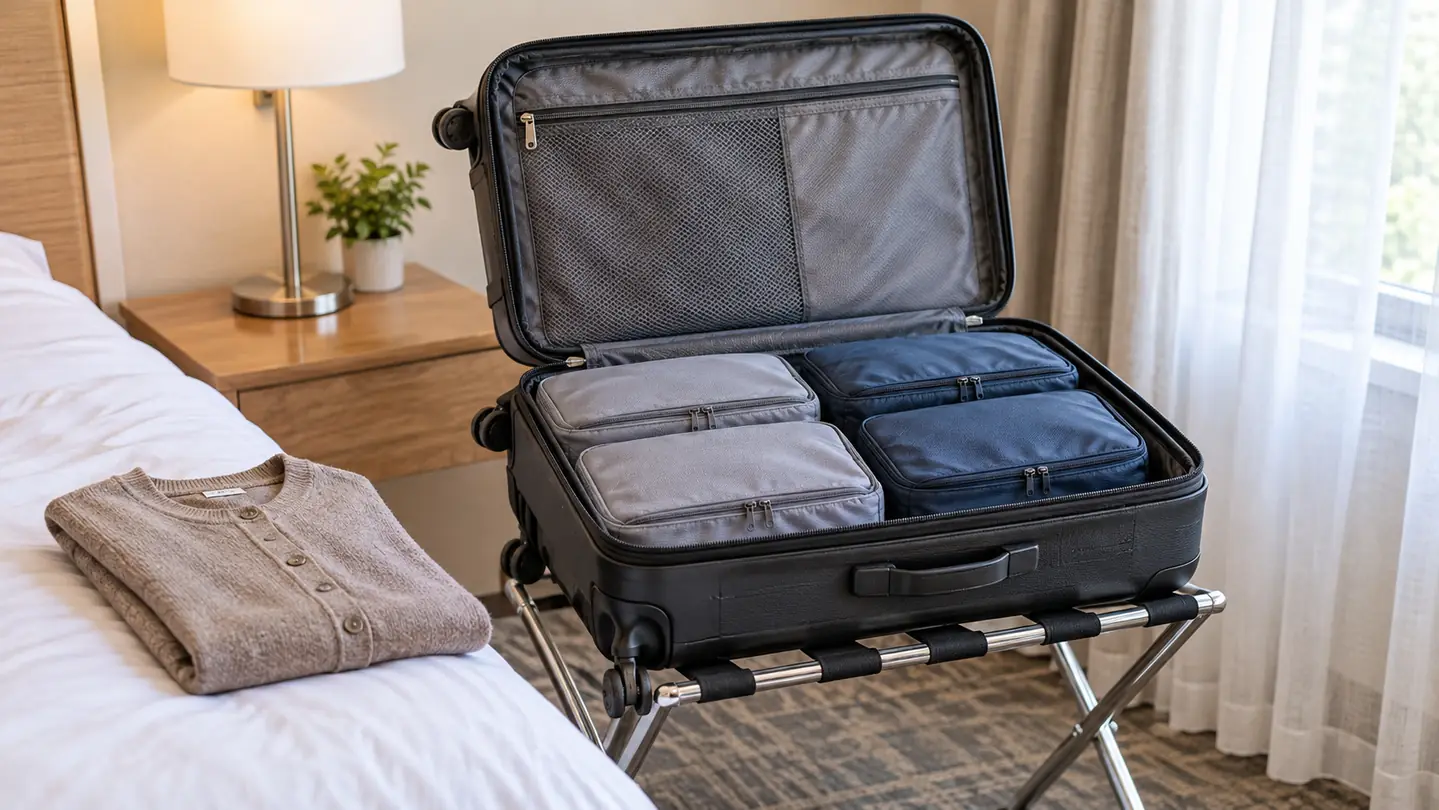
Heavy cubes go at the wheel end of the suitcase, which is the bottom when the bag stands upright. On a carry-on that usually means the medium cube if it is full of jeans, or the extra large if it is full of sweaters. Light cubes go at the top, near the handle, where you can pull one out without unpacking the bag.
This matters more as you get older, and it matters a great deal when one shoulder does not like surprises. A bag loaded heavy at the top tips when you lift it and pulls on the arm. A bag loaded heavy at the bottom sits still. Same weight, completely different feel on the walk up a jet bridge.
On the train the same rule applies in miniature. A roomette has room for a small bag and not much else, so the small cube and the toiletry bag come out and the rest stays on the luggage rack. Being able to pull one cube and leave the bag closed is the whole reason to pack this way.
The hanging toiletry bag rides flat on top, or in an outside pocket if your suitcase has one. You want it in your hand at the hotel, not buried under three cubes and a pair of boots. Same story for the charger and whatever book you are reading. Anything you will want in the first hour should not be at the bottom of the bag.
Step 5: Close, Buckle, Weigh, and Lift It Once Before You Leave
Zip every cube closed and run a thumb along the zipper to make sure it actually caught. The two-way metal zippers on this set glide, but a zipper that is half closed will open somewhere between the ticket counter and the carousel, and you will find out at the worst possible moment.
Buckle the two large cubes and give each buckle a tug. Then set the loaded suitcase on the bathroom scale. Every airline publishes a carry-on weight limit and most of them mean it. The cube set weighs 1.2 pounds, which is close to nothing, so the number on the scale is your clothes and your shoes and the hair dryer you probably do not need.
The set is rated for up to 30 pounds of contents. If your suitcase comes in heavier than that, the cubes are not the problem. The packing list is. Take out the second pair of shoes, take out the extra sweater, and weigh it again.
Then lift the bag with one hand and walk it around the bedroom. Up onto the bed, down again, tilt it back onto the wheels. If your shoulder complains in Billings, it will complain louder in the Denver airport. Pull one cube out, try the lift again, and notice the difference. That is the whole test and it costs nothing but five minutes the night before.
The entire 8 piece set weighs 1.2 pounds. My shoulder notices a paperback. It does not notice this.
What Else Helps
A few things that have nothing to do with cubes and everything to do with the trip. Write the packing list on an index card and keep it in the suitcase between trips, so each time you are editing a list instead of starting at a blank page. Leave one cube partly empty on the way out, because something always comes home with you, and a folded empty cube takes less space than a shopping bag full of loose clothes.
Air the cubes out when you get home and wipe the inside of the suitcase with a damp cloth once a season. Twill polyester does not hold odors the way canvas does, but nothing smells fresh after ten hours in a trunk or a baggage hold. Wash the shoe bag on its own, not with the clothes, and shake it out before you pack it again.
If you are checking the bag rather than carrying it on, put the toiletry bag in the middle of the suitcase, wrapped in a sweater. It is the one piece in the set that does not like being squeezed against the side of a bag that gets thrown.
And if you travel with someone who packs light, let them carry the heavier bag up the stairs. Ron has been doing it for years and I have finally stopped arguing about it. The point of a system like this is not to prove you can carry more. It is to make the trip easier on the body you actually have.
Pack the categories once, then stop thinking about it
The Veken 8 set is the one in my suitcase: extra large and large cubes with buckle straps, a medium, a small, a shoe bag, and a hanging toiletry bag with four compartments, all of it 1.2 pounds. Measure your bag, load it heavy at the wheel end, and lift it once in the bedroom before you leave.
Amazon Check Today's Price on Amazon →