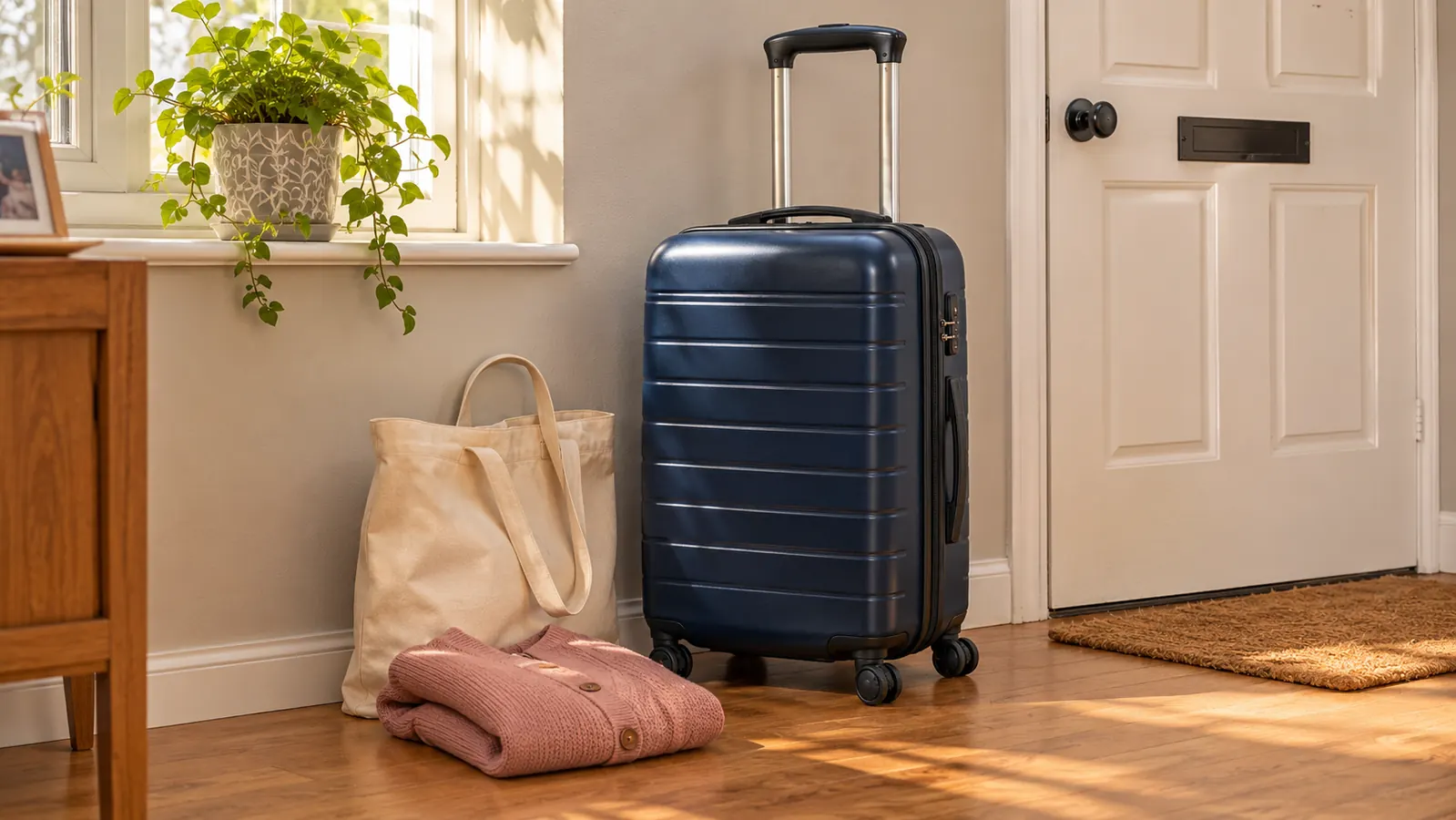
The Samsonite Freeform carry-on has lived by my front door for two years, and the side pocket is stuffed with boarding passes and train stubs to prove it. I bought it before a 6 a.m. departure out of Billings Logan, the kind of morning where you are standing in the security line at 5:40 and already tired of a soft-sided bag that flops over on its face every time you set it down. I wanted a hard shell, four wheels, and a handle that did not wobble. What I got was most of that, plus three small complaints I would hand to Samsonite in writing if anybody asked.
This is the version of the review I wish somebody had given me in the store. Not the part where the bag is wonderful, the part where you find out which details will bother you in year two. I am 64, retired from a school library in Billings, and my right shoulder aches when the weather turns. I fly to Denver to see my daughter and her family, I take Amtrak when I can talk Ron into the long way around, and I drive the silver Outback across Montana and Wyoming several times a year. The Freeform has been on all of it.
The Quick Verdict
Light, rolls beautifully on four doubled wheels, and holds more than 34 liters suggests. The telescopic handle has play in it, and the 23 inch height is worth checking against your airline before you fly.
Amazon Check Today's Price →If you want a carry-on that still rolls straight in year two, start here
Four spinner wheels, 6.5 pounds empty, and a textured shell that hides two years of airports. This is the bag I keep reaching for before a 6 a.m. flight.
Amazon Check Today's Price on Amazon →How I've Used the Samsonite Freeform
Two years, and I can list the trips. Four round trips from Billings to Denver, two long rides on the Empire Builder, a drive to Sheridan and back for a funeral, and a week in Missoula where the bag never left the back of the Outback. The first Denver run was in early September, the week my granddaughter started second grade, and I had the bag packed four days early because I was that pleased with it. The funeral drive came in February on snowpacked roads, and the bag rode in the back beside a duffel without shifting once. Ron carries the heavier suitcase because he is 66 and stubborn about it, which means the Freeform has been mine to lift, roll, and wrestle onto racks the whole time. That is exactly the test I wanted it to pass.
The first thing I noticed at the airport is how little effort it takes to move. Four wheels, and the bag goes sideways as easily as it goes forward, which matters on a jet bridge when a family with a stroller is coming through and you need to get out of the way in a hurry. My old bag had two wheels and I dragged it behind me at an angle like a stubborn dog on a leash.
One more thing from that first year. I expected a hard shell to feel clumsier than fabric, and it does not. What it feels like is a box that keeps its shape, so it slides into a car trunk and stays where you put it instead of sagging into whatever space is left. Loading the Outback for a Wyoming drive takes me about fifteen seconds now.
The second thing I noticed is the handle. Not broken, just loose. There is a small amount of side to side play when it is fully extended and you are walking fast. Two years in, it has not gotten worse and it has not gotten better. Hold that thought, because it is the main thing I would change.
The 23-Inch Measurement Is the Part Nobody Explains
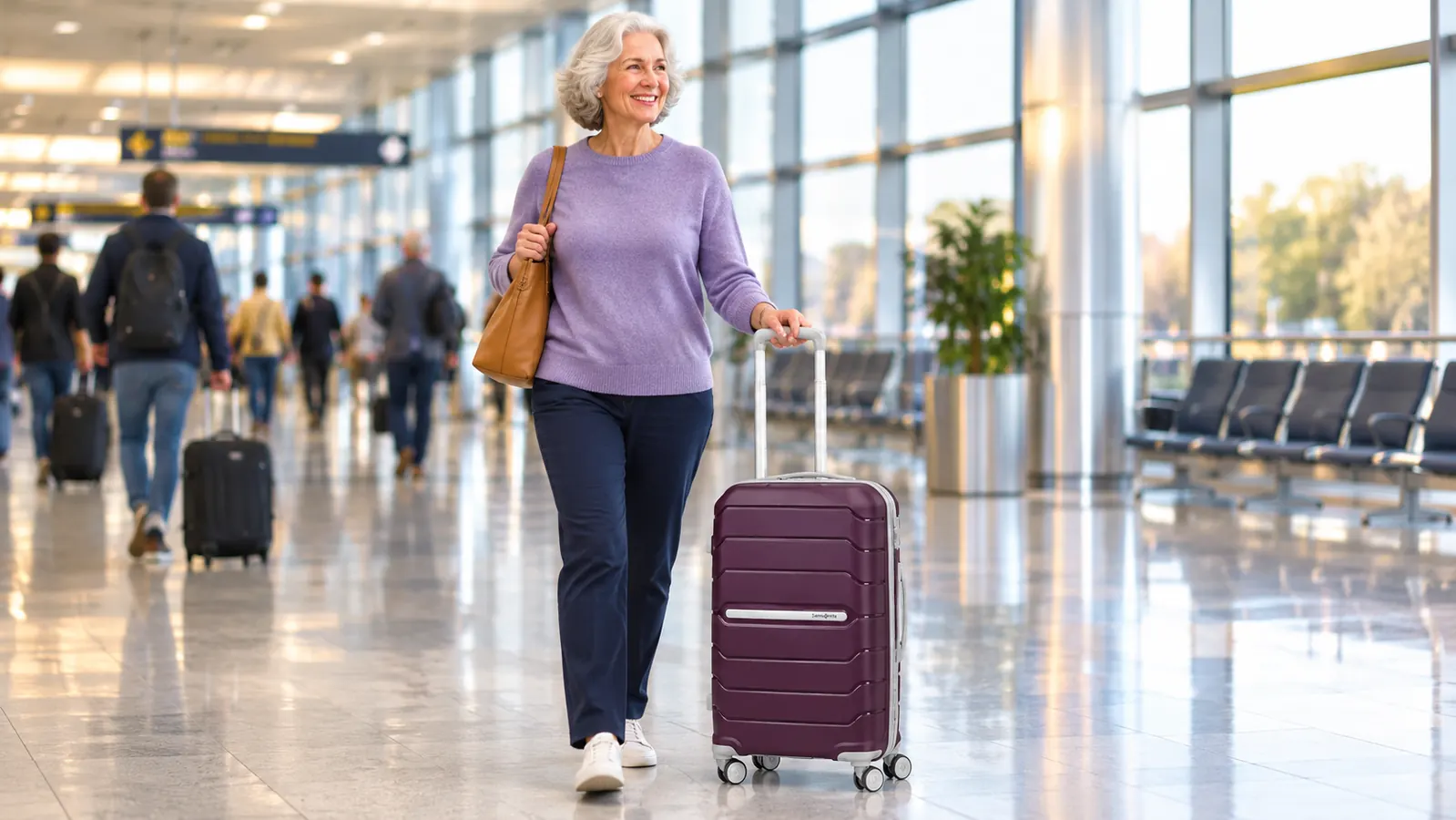
The listing gives the outside as 23 inches tall, 15.3 inches wide, and 9.8 inches deep, with the wheels and the handle hardware counted in. That is the honest way to measure a suitcase, and it is also the number that trips people up, because a lot of airlines publish a carry-on limit that reads like 22 inches and then never take out a tape measure at the gate. I measured it myself on the kitchen counter with Ron's old surveyor tape, wheel to handle, and got 23 inches on the nose. Then I measured the bag a friend bought as a 22 inch carry-on and got 22 and a half, which tells you how loose those labels really are. In eight flights nobody has looked twice at this bag. If you are the sort who reads the fine print, know that you are trusting the sizer, not the printed limit.
What I will not tell you is that it fits every bin on every plane. On the regional jets between Billings and Denver it goes in on its side with a small shove. On a full-size jet it drops into the overhead with room left over for a coat on top. On one very crowded flight to Denver the gate agent asked for volunteers to check bags, and I handed mine over without a fight, because that is what you do. It came back on the belt with one new scuff on a corner and nothing broken inside.
Depth is where the honest caveat lives. Nine and eight tenths inches closed is fine for a bin. The bag expands, and expanded it gets deep enough that a regional jet overhead becomes a gamble instead of a sure thing. I use the expansion on the trip home, after I have bought books for my granddaughter, and on those days I plan to gate check and stop arguing with physics.
What 6.5 Pounds Feels Like by the End of a Travel Day
Six and a half pounds empty is light for a hard shell, and light is the whole reason I bought it. I can lift it over my head with one hand, which is not a sentence I could write about the bag it replaced. On the Empire Builder there is a luggage rack above the seats and a step stool in the vestibule, and getting the Freeform up there by myself, at 64, with a shoulder that files complaints, is something I can still do without asking Ron for help. I weighed it on the bathroom scale before our last trip, packed for five days, and it came to 27 pounds. That is a number I can still lift into a bin, but only with two hands and a breath first, and only if I am not also holding a coffee.
Rolling is where this bag earns its keep. The wheels are doubled, two at each corner, and they cross the metal seam strips in a station floor and the rubber mats at a checkpoint without catching or spinning out. The multi directional part is real and not marketing talk. I can pull the bag beside me instead of behind me, which keeps it out of the way of the person behind me in line, and that person is nearly always in more of a hurry than I am.
Here is what I would tell a friend standing in the luggage aisle. The weight number matters less than the wheels. A seven pound bag with good wheels is easier on a sore shoulder than a five pound bag you have to drag at an angle. Buy for the roll first and the scale second, and you will be in a better mood at the end of a long day.
Six and a half pounds, four doubled wheels, and after two years of airports and train platforms the only thing I would change is a bit of rattle in the handle.
The Handle Is the One Thing I Would Redesign
The telescopic handle extends and locks where you set it, and it has a little side to side movement when it is out. Not enough for the bag to drop or tip. Enough that your hand notices it every time you start walking. I noticed the play most in the Denver airport, on the long walk from the underground train up to the concourse, where the floor is smooth and you are moving fast and the bag has to keep up with you. It kept up. It just chattered a little while it did. Two years of use has not made it worse, and I have mostly stopped thinking about it, except when I sit down to write something like this and have to be honest.
There are two handles: the telescopic one you pull and a padded grab handle on top. The grab handle is the one I use to lift the bag out of the back of the Outback, and it is soft enough that it does not cut into your fingers when the bag is full. That handle has held up with no fraying and no give.
The fix I would ask for is simple. Tighten the extension. A bag finished as well as this one should feel solid in the hand, and right now it feels a half step short of solid. That is a small complaint from a woman who has hauled worse luggage through worse places, and I want to be clear that it is a complaint and not a reason to skip the bag.

What the Inside Actually Holds
The interior measures 20.5 by 14.5 by 9.8 inches, and the listed capacity is 34 liters. Those numbers mean nothing until you pack them, so here is a five day October trip to Denver. Five shirts, two pairs of trousers, a cardigan, underthings, a toiletry bag, chargers, a paperback, and my slippers, with a little room left for whatever I buy on the way home. I am not a light packer. I am a reasonable packer who finally admitted she does not need four cardigans for four days. I pack with two cubes and a shoe bag, which sounds fussy until you have watched a hard shell turn a loose pile into a jigsaw puzzle on a hotel dresser. The cubes lie flat against the bottom and the shell closes without a fight.
The bag has three sections, and the divider panel is the part I would miss most if it were gone. Folded clothes stay folded when the bag stands upright at the foot of a hotel bed. My old soft bag had nothing dividing it, so every trip ended with me repacking a slumped pile at 6 in the morning, which is nobody's idea of a vacation.
One warning about packing a hard shell, and this is not Samsonite's fault. There is no give. A soft bag lets you shove one more sweater in and zip it with your knee. This one does not. If you overpack it, the shell will not stretch and the zipper takes the strain, so pack it to the line and save the expansion for the trip home instead of stuffing it at the start.
The lock is a combination lock built into the shell. The listing calls it TSA friendly, and I believe that, but I have never used it, because this bag stays with me and a carry-on that never leaves your sight does not need locking. Set the combination once, write it down somewhere you will actually find it, and then forget the whole thing. That is the full extent of my advice on the lock.
The Shell, the Scratches, and the Weather
The shell is polypropylene with a texture to it, and the listing calls it scratch resistant. After two years of baggage handlers, train vestibules, and the back of a Subaru, there are four visible scuffs, all on the corners, and no cracks anywhere. Scratch resistant is not scratch proof. Anyone who tells you their hard shell still looks new after twenty flights is either not looking or not flying.
The texture does real work. A smooth shell shows every fingerprint and belt mark. This one hides most of it, and it gives you something to grip when you are carrying the bag up a stairwell at a small station where the elevator is out. That happened in Whitefish. Ron took his own bag up and I took mine, and neither of us fell, which at our ages is the standard we hold ourselves to.
Water resistant is the phrase the listing uses, and it is the right phrase. The bag has been rained on twice, once on a platform in Havre and once in the parking lot at the Billings airport, and everything inside stayed dry. I would not park it in a puddle and I would not check it to Seattle in November and expect a dry sweater at the other end. Water resistant and waterproof are different words, and Samsonite used the accurate one.
What I Liked
- Rolls straight on four doubled wheels, including across the metal seam strips in a train station floor
- 6.5 pounds empty, light enough to lift overhead with one hand and a sore right shoulder
- 34 liters inside with a divider panel that keeps folded clothes from sliding into a heap
- Textured polypropylene shell hides scuffs and shrugs off rain on a platform
- Expands for the trip home after the bookstore stop
Where It Falls Short
- Noticeable side to side play in the telescopic handle when it is fully extended
- 23 inches tall is above the limit some airlines print, even though nobody has ever questioned it
- The built-in combination lock is one more thing to remember and I have never once used it
- Expanded, it gets deep enough that a regional jet overhead is a gamble
- Only two handles, so lifting a full bag out of a car trunk is a two hand job
Who This Is For
This bag suits a traveler who is past the stage of proving anything and just wants the trip to be easier. If you have a shoulder or a wrist that has opinions, if you are lifting a suitcase into an overhead bin or onto a train rack by yourself, and if you take three or four trips a year rather than thirty, the Freeform is a sensible buy. It suits the woman who flies to see grandchildren and the man who takes the train because he likes the window. It also suits anyone who has ever stood at a carousel at midnight waiting for a bag that never needed to be checked in the first place.
Who Should Skip It
Skip it if you check a bag every single time and want something that can take a decade of belt loaders and baggage carts, because a carry-on is not built for that life. Skip it if you pack for two weeks in one bag, since 34 liters is generous for a carry-on and still not a closet. Skip it if you need something that slides under the seat in front of you, because this one belongs in the overhead. And if a small rattle in a handle extension would bother you every day of a trip, look for a firmer pull, because this one will remind you it is there.
The bag I would buy again, with my eyes open about the handle
Four spinner wheels, 6.5 pounds empty, 34 liters inside, and a shell that hides two years of airports. If the 23 inch height works for your airline, it is an easy yes.
Amazon Check Today's Price on Amazon →