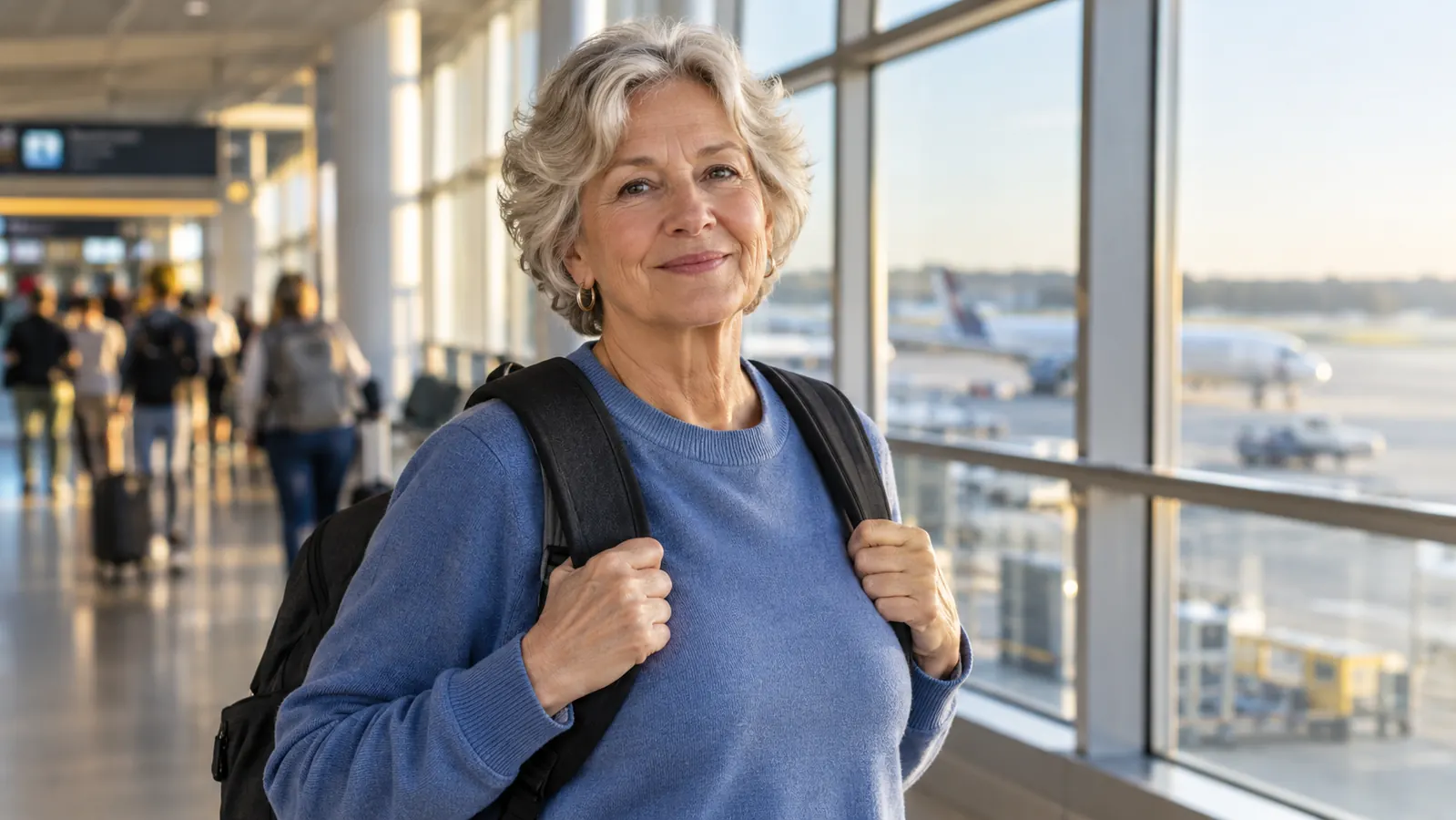
Six years ago I stood in the aisle of a plane out of Billings, Montana, with a backpack hanging off my right shoulder and a hot poker running up the side of my neck. My right shoulder has been stiff since an old injury, and a one-shoulder carry turns a two-hour flight into a three-day ache. I tried the small roller bag that tipped over in the aisle. I tried the duffel with the thin strap that cut a line into my collarbone. I tried the tote that felt sensible in the store and became a punishment by the second gate. What finally changed things was not one clever trick. It was a short list of habits, plus a bag that suits them: the Taygeer Carry On Backpack, a 35L underseat travel backpack. This is the list I wish someone had handed me at the ticket counter.
I am 64 now, a retired school librarian, and I travel several times a year. I fly to Denver to see my daughter's family, I take Amtrak's Empire Builder when we want the long scenic route, and I drive the Subaru when the trip stays inside Montana and Wyoming. Ron, my husband, packs lighter than I do and takes the heavier bag, which helps, but he cannot carry my bag up the jet bridge for me. So the habits had to be mine. Here they are, in the order I actually do them.
Pick a bag your shoulder can live with
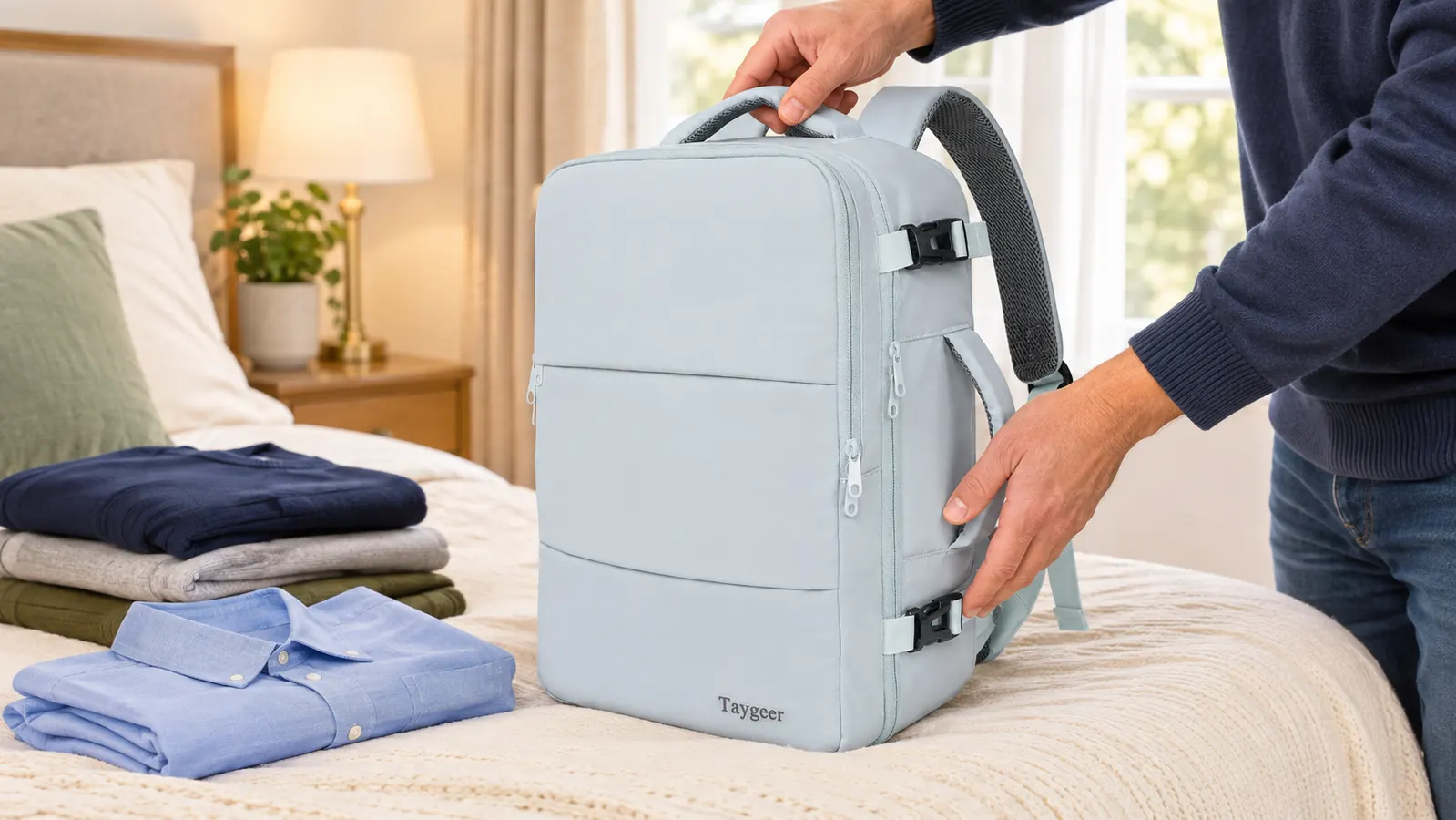
The Taygeer Carry On Backpack weighs 1.74 lb empty and measures 16.8 by 11 by 7 inches, with adjustable shoulder straps and a 180 degree zipper closure that opens flat at security.
Amazon Check Today's Price on Amazon →Step 1: Wear Both Straps, Even for the Short Walks
The biggest change cost nothing at all. I stopped using one strap. For years I told myself the walk from the car to the counter was too short to bother, and the walk from the counter to the gate was shorter still. Then I added up all those short walks across one travel day and realized I had been hanging fifteen pounds off one side of my body for the better part of an hour, in pieces.
So now the bag goes on both shoulders before I take a single step, including the ten feet from the car to the curb. Loosen the adjustable straps first so the bag sits low, slide both arms in, then pull the straps down until the bag rests snug against your back instead of swinging. That is the whole technique. It takes four seconds and it is the difference between arriving in Denver feeling like a person and arriving feeling like a question mark.
Last April I actually tested it, because I am the sort of person who needs the proof written down. I wore the bag on one strap from the check-in desk to gate B4 in Billings, a walk of maybe four minutes if you count the stop at the water fountain, and my shoulder was still grumbling when we landed in Denver. On the way home I wore both straps over that exact same walk and felt nothing at all. Same bag, same weight, same shoulder. That settled the argument for good.
One more thing about this step. If your shoulder is bad enough that even two straps hurt, that is a conversation for your doctor, not for a retired librarian in Billings. My rules are only mine. But the principle holds for almost everyone: two straps spread the load, one strap concentrates it, and the concentration is what your neck remembers three days later.
Step 2: Weigh the Packed Bag Before You Leave the House
The Taygeer bag is light before you put anything in it, 0.79 kg, or 1.74 lb. That matters more than it sounds, because every ounce you save on the bag is an ounce you can spend on the things you actually need. But the empty weight is not the number that hurts you. The packed weight is.
I keep an old kitchen scale in the hall closet and I put the packed bag on it the night before a trip. My limit is the weight I can lift with one hand from the kitchen counter down to the floor without leaning or bracing. If I have to use both hands and a knee, it comes back out. I aim for around fifteen pounds packed. The bag itself is under two of those, so my clothes, toiletries, my reading glasses and whatever Ron has decided not to pack all have to fit in the other thirteen. When the scale reads eighteen, something has to go, and it is almost never the thing I assumed it would be.
What usually comes out is the second pair of shoes, the hardcover book I will not read, and the full-size bottles I brought because I did not want to decant. What usually goes back in is a lighter jacket and one more pair of socks. The bag still holds a week of clothes for me. It just holds them at a weight I can carry instead of a weight I can survive. I have repacked that bag at ten at night more times than I can count, and I have never once regretted it at the airport the next morning.
Step 3: Pack the Weight Against Your Spine
Where the weight sits inside the bag matters as much as how much there is. The Taygeer has three main compartments plus a utility pocket, and I use them in a fixed order so I never have to think about it. Heavy things go in the compartment closest to my back. Shoes, the hair dryer, the jar of whatever I am bringing to my daughter, all of it goes against my spine. The soft, light things go in the outer compartment, where they act as a cushion instead of a lever.
The bag comes with a bonus shoe bag, and I use it every trip. Shoes go in the shoe bag at the bottom, which keeps grit off my clothes and keeps the weight low and centered. There is also a wet pocket, which I have used for a damp swimsuit, a leaking toiletry bottle, and once a washing cloth full of hotel sink water. Any of those loose in the main compartment would have ruined a good sweater.
The dimensions are 16.8 inches tall, 11 wide, and 7 deep, and that seven inches is the number I care about most. It means the bag stays slim enough to sit flat instead of bulging into a ball behind my heels. The laptop section takes a device up to 15.6 inches, and the utility pocket holds the small things I want without unzipping the whole bag: my glasses case, my boarding pass, a pen. I packed five days in Denver in February with that layout exactly: four shirts, a wool sweater, one pair of jeans, socks and underthings down the middle, the shoe bag at the bottom holding a second pair of walking shoes, and the toiletries in a quart bag flat against the back wall. It zipped without a fight and it weighed sixteen pounds on my kitchen scale.
The bag was never the whole problem. How I picked it up was.

Step 4: Adjust the Straps in This Order
There is a right order to the adjustable straps and it took me a shamefully long time to find it. Loosen both straps all the way out while the bag is still on the bed or the seat. Then put the bag on. Then tighten. If you tighten first and try to put the bag on, you are wrestling a bag that is already committed to a shape that is not yours.
Do the adjusting standing up, never sitting down in the gate seat. When you sit, the bag rides up and the straps go slack, and then you stand and the whole thing shifts. I stand, snug the straps, do one small shrug to settle the bag, and sit back down. It looks fussy. It saves me a knot between my shoulder blades.
Then check it again after security. Taking the bag off and putting it back on three times in ten minutes always throws the adjustment off a little. Thirty seconds of re-tightening at the bench past the checkpoint is the cheapest comfort available in an airport. It also gives you a moment to notice that one strap has walked itself long again, which is the kind of thing you only find out about halfway down a jet bridge if you skip the check.
Step 5: Change How You Handle It in the Airport
The Taygeer has a 180 degree zipper closure, which means the bag opens flat like a book at the security lane instead of gaping open at one end. That single design detail changed my security routine. I lay it flat in the bin with the laptop section facing up, and I am not digging elbow deep in a tube while the line sighs behind me. My shoulder does not get a vote because my shoulder is not doing the work.
The bag is water resistant with a zipper closure, so a wet walk from the curb to the doors is not an emergency. I still keep my passport and my paperback in a plastic sleeve, because water resistant is not waterproof and I am not interested in testing the difference in a downpour in Minneapolis.
The other half of this step is lifting. I never lift the bag from the floor with one hand and a twist. I bend, take the top handle with both hands or use the seat of a chair as a step, and stand up straight before I swing it onto my back. The bag is sold as a carry-on and it fits in the space in front of my seat, which means I am lifting it twice per flight, and twice is enough to do properly. I learned that rule the hard way at a rental counter in Bozeman, where I swung the bag up off the floor with one hand and spent the next two days with a headache that started at the base of my skull and ended behind my right eye.
What Else Helps
The honest answer is that a backpack cannot do everything, and the trips where I bring my little four-wheel roller instead are the ones with long airport walks. Denver is a long airport. If I have a tight connection and two concourses to cross, the roller comes and the Taygeer stays home, because pulling a bag behind me asks nothing of my shoulder at all. Four spinner wheels are the kindest thing ever invented for a traveler over sixty.
Ron helps, and I let him. For years I did not, out of some stubborn idea about carrying my own things, and all it bought me was a sore week. Now he takes the heavier bag at the stairs and I take the lighter one, and neither of us makes a speech about it. If you travel with someone, work out the division before the trip, not in the jet bridge.
A few smaller things earn their space. I pack a light scarf I can fold into a pad under one strap on the days my shoulder is talking to me. I wear a cardigan with pockets so my boarding pass and my glasses do not live in my hands. And I take ten minutes the night before to lay everything out where I can see it, because packing in a hurry is how a bag gets heavy. None of this is complicated. It is just the difference between treating your shoulder as a problem to solve and treating it as an inconvenience to push through.
I have never once regretted repacking the bag at ten at night. I have regretted every trip where I did not.
The habits are free. The bag is the easy part.
35L, underseat, water resistant, 1.74 lb empty, with adjustable straps, three main compartments plus a utility pocket, a bonus shoe bag and a wet pocket. Light enough that the bag itself is never the reason your shoulder aches.
Amazon See the Taygeer Carry On Backpack on Amazon →