

I bought the Taygeer carry on backpack in March, before a stretch of trips that turned out to be a fair test: two round trips from Billings to Denver to see our daughter's family, a long ride on Amtrak's Empire Builder, and a few drives across Montana and Wyoming in the silver Outback. I am 64, retired from the school library here in Billings, and I have a right shoulder that files a complaint after every bag I carry. That shoulder is why I pack light. Not virtue, just arithmetic.
So this is not a first-week impression. It is the review I wish I could have read before I clicked buy: what held up over months of real use, what quietly annoyed me, and who this bag is actually built for. If you are past sixty and tired of wrestling a suitcase through a concourse, some of this will sound familiar.
The Quick Verdict
Slides under the seat on every flight I took it on, weighs 1.74 pounds empty, and holds a week of clothes if you pack like an adult. The shoulder straps are the compromise.
Amazon Check Today's Price →The bag that got me out of the gate-check line
16.8 by 11 by 7 inches, 35 liters, 1.74 pounds empty. It fits the space under the seat in front of you, which means it stays with you instead of riding in a cart to baggage claim.
Amazon Check Today's Price on Amazon →How I've Used It
The Denver flights are the real test. Billings to Denver is a short hop, but it is usually a small plane, and small planes are where personal items get gate-checked at the last minute because the bin over your seat is barely a bin. I put the Taygeer under the seat in front of me on all four legs of those trips. It went in with a shove from my foot and I still had room for both of mine. Nobody at the gate ever asked me to check it. That single thing changed how I travel, because what I dread is standing at the end of a jet bridge watching my bag disappear onto a cart with a tag on it. One Tuesday in April the flight was full and a woman two rows ahead of me was told at the door that her bag would have to be checked. She had a soft duffel not much bigger than a grocery sack and she spent the whole hour worrying about whether she would see it again in Denver. Mine stayed at my feet the entire way.
The Empire Builder was a different job entirely. Two days on a train means you live out of your bag, and the opening is what made that bearable. On the train I set it flat on the bunk, took out what I needed, closed it, and slid it under the little table by the window. No digging in from the top like a raccoon in a trash can. Ron, who is 66 and packs in about eleven minutes flat, kept saying he wished his bag opened the same way. He carried the heavier suitcase on that trip, as he always does, and I did not once ask him to take mine.
The road trips were the least interesting use and maybe the most honest one. A bag that lives in the back of a car for four days gets thrown around, sat on, and used as a pillow once. Nothing tore. The zippers still run. There is a scuff on one corner from me dragging it across a parking lot in Sheridan, and in six weeks that scuff has not spread or frayed into a hole, which tells you something about how the outside is put together.
What I have not done with it is anything rugged. No hiking, no camping, no standing in a downpour. I am a woman who flies to see grandchildren and takes the train when the scenery is worth it, and I am reviewing it as that. If you need a bag for a trail, this is not the one and I would not pretend otherwise.
What 35 Liters Actually Holds
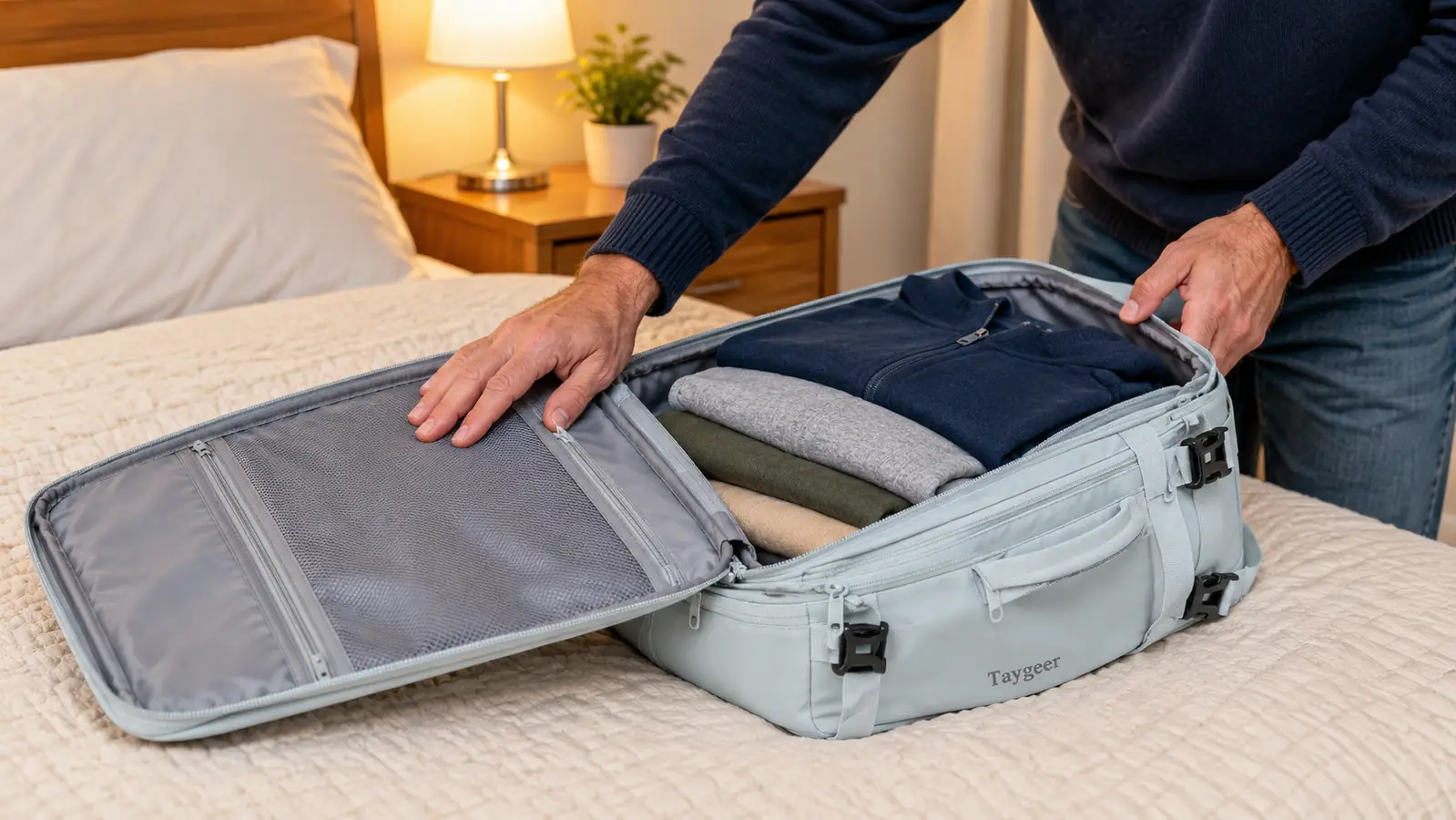
Thirty five liters sounds like a number on a tag until you pack it. Here is what went into it for the Denver week: four tops, two pairs of slacks, one pair of jeans, a thin cardigan, underthings, a small toiletry pouch, my medications, a paperback, my phone charger, a folding umbrella, and a pair of walking shoes in the shoe bag that comes with the bag. It closed without me kneeling on it. That is the short version of this whole review.
The layout is what makes that possible. There are three main compartments plus the smaller utility pockets, and the split matters more than the total. I keep clothes in the large rear section, the things I want during a flight in the front section, and shoes or laundry in the section that separates them. When a bag is one big hole, everything migrates to the bottom of the hole by day two and you spend the trip excavating. This one holds its shape well enough that I can reach in and put my hand on what I want.
The shoe bag and the wet pocket earned their keep on the train. I had a damp washcloth and a travel cup that had not dried out, and both went into the wet pocket instead of against my clean clothes. The shoe bag did the same job for a pair of shoes that had been on the floor of a Denver restaurant. Small features. But they are the difference between a bag you tolerate for one trip and a bag you keep reaching for.
There is a limit to how much the layout can do for you. On the longer trip I packed the rear section full to the zipper and the front section had to give up its floor space, so the two effectively merged into one compartment by the second day. That is not a flaw exactly, but it tells you what this bag is: the organization is a four or five day feature, not a two week one. Pack it for a week and the sections do their job. Pack it for a fortnight and you are back to rummaging.
The 180 Degree Opening Is the Best Part
The zipper runs around the outside of the bag, so it opens flat like a book instead of gaping at the top. In a hotel room that means you set it on the luggage rack and everything you packed is visible at once. On a train bunk it means the same thing in a third of the space. At security it means you are not the person holding up the line, pawing through a top-loading sack while a stranger behind you sighs.
One caution, and it comes from experience rather than theory. A bag that opens flat is a bag that opens flat when you would rather it did not. My first week with it, I picked it up by the top handle with the main zipper partway open and everything slid out onto the floor of the Denver airport, in front of a family with three children. That was my fault and not the bag's, but if you are used to a tote that stays shut, give yourself a week to build the habit. I check the zipper pulls now the way I check for my car keys.
Taygeer fits a laptop up to 15.6 inches in the padded section, which I use for my tablet and a folder of papers rather than a computer. I have watched younger travelers pull a laptop out of this thing at security without taking the whole bag apart, and it looks simple enough that even I could manage it.
Carrying It With a Stiff Right Shoulder
Here is where I will be honest with you. The straps are padded and adjustable, and for the walk from the car to the gate they are perfectly fine. But this is a 1.74 pound bag that can hold a good deal more than 1.74 pounds, and by hour three in an airport my right shoulder knows the difference. A backpack puts weight on both shoulders, which beats a tote hanging off one, but no backpack is a set of four spinner wheels, and I would be lying if I said it was.
The way I solved it was to pack it lighter than I could have. I wear my bulkier shoes on the plane and put the small pair in the shoe bag, which keeps the whole thing around twelve pounds instead of twenty. At that weight the bag is comfortable for a full travel day, including the long walk at the Denver airport where the train between concourses is somehow always at the far end. The first time I made that walk I had the bag loaded to about seventeen pounds, and I stopped twice to set it down and swap which hand held the strap. The second time, at twelve pounds, I went the whole way without stopping and did not think about my shoulder again until I was sitting in the car.
When it is full, it slumps forward a little, the way soft bags do. That is not a defect, it is just the nature of the material, and it is the reason I carry it on my back rather than perching it on the handle of a rolling suitcase. On my back it sits close and stays put. Perched on a handle, it leans.

How It Has Held Up, and the Small Stuff
Months in, this is the boring list that actually matters. The zippers still run smoothly and none has split. The stitching at the strap anchors has not frayed, and that is the failure point on every inexpensive backpack I have owned in my life. The fabric is water resistant rather than waterproof, which means a light rain in a parking lot is fine and a Montana downpour will eventually get through. I keep a plastic bag inside for my medications and I have not needed it yet. By now I have loaded and emptied it for nine separate departures, and not one zipper pull has come loose. The one thing that has changed is the shape. The top has softened and it no longer stands up on its own when it is empty, which is simply what happens to a soft bag and is not a complaint.
There is decorative detail on the front of the bag that I did not care about when I ordered it and do not notice now. What I do notice is that the exterior pockets are easy to reach while the bag is on my back, which is not true of every bag I have tried. The thing I would change is the strap padding. It is thin enough that I feel the edges after a few hours, and a slightly wider pad would turn this from a very good bag into the one I recommend without a caveat.
What I Liked
- Went under the seat on every flight I took it on, including the small planes into Denver
- 1.74 pounds empty, light enough that my bad shoulder does not complain on a normal travel day
- Opens 180 degrees flat, so you can see everything you packed without unpacking
- Three main compartments plus utility pockets, which keeps clothes, shoes and snacks from becoming one pile
- Shoe bag and wet pocket included, and both got real use on a two day train trip
- Water resistant fabric handled light rain and a scuffed parking lot without damage
Where It Falls Short
- Strap padding is thin, and I feel it after a few hours at heavier weights
- Soft sided, so it slumps forward when packed full and does not perch well on a suitcase handle
- The flat opening works both ways: leave the zipper partway open and your belongings end up on the floor
- Not waterproof, and not built for trails or rough handling
I put it under the seat in front of me on all four legs of those Denver trips, and nobody at the gate ever asked me to check it.
Who This Is For
This bag is for the traveler who is tired of the baggage carousel and willing to pack with some discipline to avoid it. If you take three or four day trips, fly on small planes, ride trains, or drive somewhere and stay in a hotel where you would rather not unpack everything onto a shelf, it does the job well. It is especially good for anyone with a shoulder or back that objects to a one-strap bag. Two straps and a light load beats one strap and a heavy one, every time.
It also suits people who like to know where their things are. The compartment layout means the bag has a place for clothes, a place for shoes, a place for the wet washcloth, and a place for the book you are halfway through. I am a retired librarian and I have opinions about systems, and this one is sensible. Taygeer built a bag that a person who likes order can live out of for a week.
Who Should Skip It
Skip it if you are a heavy packer or if you take trips longer than a week with one bag. Thirty five liters is generous for four or five days and cramped for twelve. Skip it, too, if you have a shoulder or back problem that makes any backpack a bad idea. A bag with four spinner wheels and a rigid handle is kinder to a bad shoulder than anything you wear, and I say that as someone who wanted this to be the answer and found it was only most of the answer.
And skip it if you want a bag you can toss in the dirt. This is a travel bag for airports, train stations and hotel rooms. It is water resistant, not waterproof, and the fabric is not built for rocks and branches. Buy it to get on a plane without checking a bag. Do not buy it to go up a mountain.
If your shoulder has opinions, start here
Two straps, 1.74 pounds empty, and a flat opening that lets you pack and unpack without a search party. It is the bag I now reach for first, and I reach for it with a bad shoulder.
Amazon Check Today's Price on Amazon →