Short answer first. If you want one bag that carries four or five days of clothes and still slides under the seat in front of you, the Taygeer carry on backpack is the one I would buy again. If you pack for two nights and want the lightest thing you can put on your back, look at the ECOHUB before you spend anything. That is the comparison in two sentences. What follows is the reasoning, including the two places where the ECOHUB is genuinely the better bag.
I am 64, retired from a school library in Billings, Montana, and I travel several times a year. I fly to Denver to see my daughter's family, I take the Empire Builder when the schedule allows it, and I drive the Outback on the long Montana and Wyoming runs. My right shoulder aches from an old injury, so how a bag carries matters more to me than how it looks. The Taygeer has been my personal item for most of a year now. The ECOHUB I borrowed from my daughter for a two night trip to Denver, which is long enough to learn how a bag feels on the walk through a terminal and not long enough to know how it wears over years.
| Taygeer | ECOHUB | |
|---|---|---|
| Stated size | 16.8 x 11 x 7 inches, which the listing calls 35 liters | A smaller personal item bag; check its own listed figures against your airline |
| Empty weight | 0.79 kg, about 1.74 lb | Not stated the same way on the listing I read |
| Laptop | Fits a device up to 15.6 inches | Not what I would choose it for |
| Shoes and damp clothes | Bonus shoe bag and a wet pocket included | No equivalent listed that I could find |
| Getting through security | 180 degree zipper closure opens it flat like a book | I only tested ours, so call this one unproven |
| Water resistance | Listed as water resistant | Both are soft fabric bags, and neither is a dry bag |
| Packing discipline | 35 liters invites you to fill it, and full it is a load on one shoulder | A smaller bag keeps you to a two night load |
| Room in a tight space | 16.8 inches tall, so it takes the legroom it stands in | Tucks into a train seat gap and a car footwell more easily |
| Price | Check today's price | Check today's price |
Where Taygeer Wins
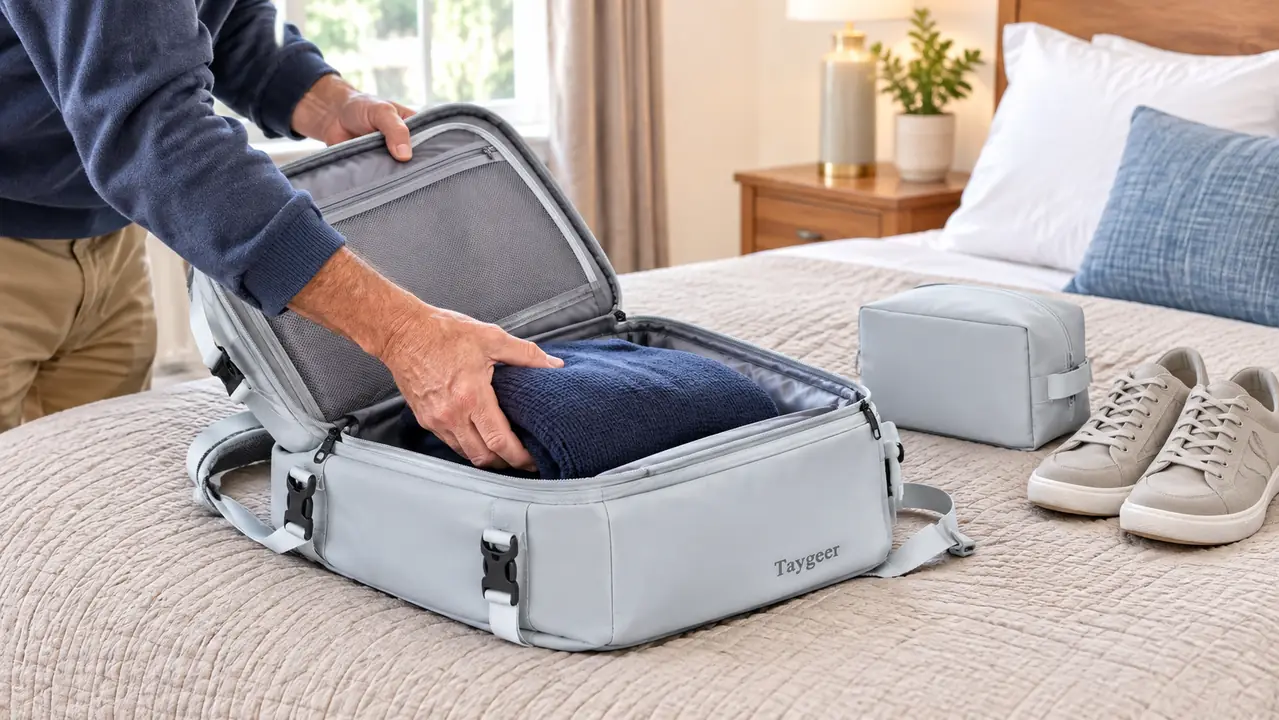
The number that decides this for me is 16.8 by 11 by 7 inches, which the listing calls 35 liters. That is the difference between a personal item and a purse with ambitions. On the flight to Denver I pack four days of clothes, a pair of walking shoes in the shoe bag that comes with it, my toiletries, a paperback and the charging cables, and it closes without me sitting on it. Then it goes under the seat. The ECOHUB I borrowed would not have taken the shoes and the sweater both, and that is less a criticism of the bag than a fact about sizes. I measured the Taygeer on the kitchen table with Ron's tape before the first trip, because I have been burned before by a bag that claimed a size and arrived bigger. Sixteen and eight tenths tall, eleven wide, seven deep. I wrote the numbers on an index card and I keep it in the front pocket. When I book a flight I read the airline's personal item limit and hold the card up against it. That ritual takes two minutes and it has not failed me yet.
The laptop sleeve is the other thing I underrated. It fits a device up to 15.6 inches, which means my old laptop rides in a personal item instead of staying home. Past that there are three main compartments and a utility pocket, and the listing mentions a wet pocket, which I have used for a damp washcloth and once for a plastic bag of seashells. The shoe bag is the piece I would miss most if I changed bags. Shoes in with clean clothes is the whole reason a trip smells like a trip.
Two smaller details that matter at a security line. The 180 degree zipper closure lets the bag open flat like a book, so I am not digging around inside a tube while a line of people waits behind me. The line at Billings is short and the one at Denver is not, and the flat open matters more at the longer one. And the bag is listed as water resistant. I got caught in a Billings rain walking from the terminal to the car and the clothes inside stayed dry, which is not the same as standing in a downpour, but it is more than I expected. Empty, it weighs 0.79 kg, so it is not the bag adding weight.
Where ECOHUB Wins
Here is the honest part, and it is the reason I did not simply tell you to buy what I bought. Thirty five liters is a trap for a woman with a sore shoulder. The bag is light when it is empty and it does not stay empty. Pack it full and you have built a suitcase with straps, and every ounce of it hangs off the same shoulder. The ECOHUB is a smaller bag, so it holds less, so I carried less. After two days in Denver my shoulder was less angry at the end of each evening, and that had nothing to do with clever design. On the second evening I walked eight blocks to a restaurant and eight blocks back, and I did not think about the bag once, which is the highest thing I can say about a bag on a sore shoulder. With the Taygeer on that same walk I would have shifted it from shoulder to shoulder twice and set it down at the corner to rest. Ron noticed before I did. He said I was standing up straighter. The Taygeer is not a bad bag for a two night trip. It is just more bag than two nights needs.
It also fits in places the bigger bag does not. It dropped into the footwell of the Outback without me shoving it, and it slid into the gap beside the seat on the train without a fight. And there is less to keep track of. Fewer compartments means fewer places to hunt. I once spent three days looking for a hair clip in the utility pocket of the Taygeer, and it turned up at the bottom of the shoe bag, which is my fault and not the bag's.
The bag that swallowed four days of clothes and still went under the seat
16.8 by 11 by 7 inches, 35 liters, 0.79 kg empty, with a shoe bag and a wet pocket in the box. It is the one I fly out of Billings with, and it fits a laptop up to 15.6 inches.
Amazon Check Today's Price on Amazon →How I Compared Them
I did not run tests. I packed both bags for real trips and paid attention. The Taygeer went to Denver twice, on the train once, and on the drive to Sheridan to see Ron's brother. The ECOHUB went to Denver for two nights on my back, not my daughter's, because I wanted to know how it felt after a terminal walk and a shuttle ride. I noted what fit, what I had to leave behind, and how my shoulder felt at the end of the day.
I also read both listings closely, because a listing tells you what the seller thinks matters. The Taygeer listing is unusually plain about numbers: dimensions in inches, weight in kilograms and pounds, a stated laptop size, a stated water resistance level. That counts for something. When a seller gives you figures, you can check them against your airline's personal item limit before you buy instead of after. I sat in the gate area at Billings Logan with my phone and read the Taygeer listing twice, and by the second read I knew it would go under the seat in front of me on the Denver flight, because 16.8 inches is shorter than my lower leg. That is not a technical test. It is the arithmetic anyone can do in a waiting area, and it is the reason I ordered this bag instead of another one with flattering photographs and no measurements on it.
The ECOHUB listing gave me less to work with on some points, and I have said so in the table rather than guessing. Where I could not confirm something, I marked it as unproven instead of filling the space with a number I made up. Assume any bag I could not measure might still be fine. It simply does not get credit for something I did not see with my own eyes.

The Shoulder Question
Ron packs light, which is a polite way of saying he carries the heavier bag, and I have leaned on that more than I should. If you travel alone, or you are the one carrying everything, then weight and strap comfort become the whole decision. The Taygeer has adjustable straps and no hip belt listed, so the load goes through your shoulders. From what I could see, that is true of the ECOHUB too. Neither one is a hiking pack.
What changes between them is how much weight there is. A small bag packed well beats a big bag packed badly, and it is easier to pack a small bag well because you have no room to be lazy. That is the strongest argument for the ECOHUB and I want to be clear that it is a real one. My answer was to keep the Taygeer and pack it half full on short trips, which sounds like discipline and is really me being too frugal to buy a second bag. I tried a shoulder pad from the hardware store first, the kind made for a tool bag, and it slid around and made things worse. What helped was taking the laptop out and carrying it in my hand through the terminal. Twelve ounces in the hand is easier than twelve ounces on a shoulder that is already complaining, and I do it now on every trip.
Four days of clothes, a pair of walking shoes in the shoe bag, a paperback and the charging cables, and it still went under the seat in front of me on the flight to Denver.
What I Would Change
Two things. The bag is deep, and small items sink. A hair clip, a pair of earrings, a transit card, all of them end up at the bottom of a compartment under a sweater. I now use two small pouches and that solves it, but a couple of shallower zip pockets on the outside would have saved me the trouble. If you are the kind of person who keeps everything in one place, this bag will teach you organization the hard way.
Second, thirty five liters is more than some carriers allow as a personal item, and the only way to know is to measure against your own airline's limit before you fly. The listed 16.8 by 11 by 7 inches fits most sizers, but not every one. I check the airline's number each time I book, and I have never been asked to gate check it. I also never fill it to the seams on the way out, which helps more than any of this.
Who Should Buy Which
Buy the Taygeer if you want one bag for a four or five day trip, you fly the same couple of airlines, and you are willing to check its size against their limit once. It is also the bag for anyone who travels with a laptop, because a 15.6 inch sleeve inside a personal item means you stop hauling two bags through a terminal. The shoe bag and the wet pocket are small things that turn out to matter more than they sound.
Buy the ECOHUB if you take short trips, if the bag rides on your back rather than on a cart, and if your shoulder is the deciding vote. It is the better bag for a two night visit to family, for a train trip where you want to walk from the station with everything you brought, and for anyone who knows they overpack and wants a bag that will not let them.
If you are stuck between the two, the question I would ask myself is how many days of clothes I actually need. Four or more, and the Taygeer earns its size. Two or three, and a smaller bag will make your shoulder happier, and the ECOHUB is a fair place to start looking. Neither choice is wrong. One is just a better match for the way you pack.
One bag, one trip, nothing checked
The Taygeer carry on backpack is 35 liters, 0.79 kg empty, water resistant, with three main compartments, a utility pocket, a shoe bag and a wet pocket, and a 180 degree zipper closure for the security line.
Amazon Check Today's Price on Amazon →